The Balance Drill Most People Skip Because It Looks Too Easy
Quick Answer: Slow, deliberate weight shifts from foot to foot. Four counts each way, ten shifts, done barefoot while the kettle boils. It rehearses the transition moments where real falls actually happen, trains ankle-level correction, and carries almost no injury risk. Progress by slowing down, not by adding wobble.
Balance training looks like wobble boards and one-legged poses held with grim determination.
The drill that probably does more for you looks like standing still and swaying gently. Which is exactly why nobody does it.

Why isn’t the slow version just a beginner shortcut?
Constant correction beats a locked hold. Deliberately slow shifts demand continuous small muscular adjustments the entire way across. A static hold finds a position and stops adjusting.
It works the full range. Shifting through the complete path from one foot to the other engages stabilizers at every point along the way, not only at the two end positions.
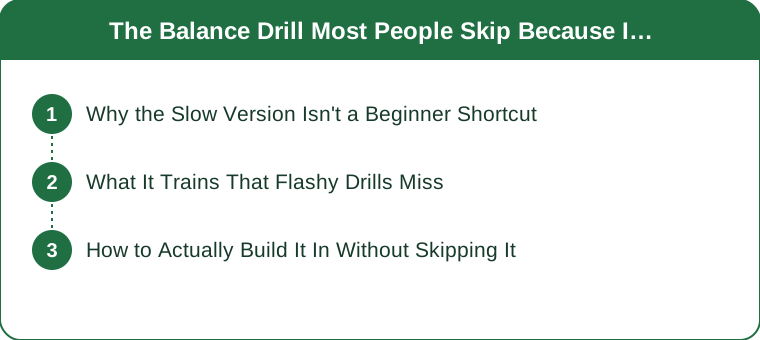
Same benefit, lower risk. It builds the same proprioceptive skill as single-leg work with far less chance of an ankle roll — a real consideration alongside vestibular balance work.
It matches walking. Weight-shifting mechanics are the pattern used in every single step you take. A static single-leg hold isn’t.
You can do it daily. Low intensity means no recovery cost, which means frequency — and frequency is what builds the skill.
The simplicity is the point, not a compromise.
What does it train that flashy drills miss?
- Transitions. Most real falls happen while stepping off a curb or turning around, not while standing on one leg. This drill rehearses exactly that.
- Ankle-first correction. It trains the ankle’s fine-tuning response before a bigger hip-level correction is needed — the first line of defense the body should reach for.
- Weight distribution awareness. You build a felt sense of how weight actually sits across the foot, which a rigid hold doesn’t teach as directly.
- A genuine on-ramp. For anyone who can’t safely hold a single-leg stance yet, this is the entry point rather than a consolation prize.
- Confidence. Low-stakes success here is what makes harder single-leg and eyes-closed work feel approachable later.

What Nobody Tells You
Speed is what ruins it. Left unmonitored, the drill quietly accelerates until it’s just swaying — at which point it genuinely is too easy. Counting out loud is the whole quality control system.
Progress means slower, not wobblier. The instinct is to add an unstable surface. Extending the count from four to eight raises the demand while keeping the risk near zero, and it’s the better progression for most people.
Barefoot changes the drill substantially. Shoes damp the sensory information your foot is trying to send. On a safe surface, going barefoot lets the foot’s own sensors do more of the work.
It reveals asymmetry immediately. One direction almost always feels smoother than the other. That gap is useful information about which side is doing less — and it narrows with practice.
Nobody skips it because it’s hard. They skip it because it’s boring and it doesn’t feel like exercise. Which is why attaching it to an existing habit matters more than any technique cue here.
How do you actually build it into a routine?
Borrow time you’re already standing. Ten slow shifts while brushing your teeth or waiting for coffee. The kitchen counter drills work on the same principle.
Count four out loud each way. Slowly. Speaking the count prevents the quiet acceleration that turns it back into nothing.
Progress by extending the count. Six, then eight. Not by adding a cushion or a wobble board.
Go barefoot when it’s safe. Let the foot’s sensors participate. Keep a counter within reach if steadiness is a concern.
Track completion, not difficulty. A simple daily check-off. Consistency builds the underlying skill; intensity mostly builds soreness.
When to talk to a professional: sudden balance changes, dizziness or vertigo, unexplained falls, numbness or tingling in the feet, or balance that’s worsening rather than holding steady all warrant a doctor’s assessment. Several treatable conditions present first as balance decline, and a physical therapist can build a program suited to your specific situation. If you’ve fallen in the past year, mention it — it’s the single strongest predictor of another fall, and it changes what the right program looks like.
FAQ
How often should I do weight-shift drills?
Daily is realistic and appropriate, since the intensity is low enough to need no recovery. Ten to twenty shifts once or twice a day, attached to something you already do, works better than a longer session twice a week.
How do I know it’s working?
Look for smoother, quieter shifts, less arm involvement, and a narrowing gap between your two directions. Our guide to signs balance training is improving covers the markers worth watching beyond how long you can stand on one leg.
Is this enough on its own?
It’s an excellent foundation and not a complete program. Once it feels easy at an eight-count barefoot, adding single-leg work, proprioception training, and lower-body strength gives you the full picture.
TL;DR:
- Slow weight shifts demand continuous correction; static holds lock in and stop adjusting.
- They rehearse the transition moments where most real falls actually occur.
- They train ankle-level correction before a bigger hip correction is needed.
- Almost no injury risk, so they can be done daily — and frequency is what builds the skill.
- Count four out loud each way; progress by slowing to six or eight, not by adding instability.
- Attach it to an existing habit, and see a doctor about sudden balance changes, dizziness, numbness, or any fall in the past year.
Keep Reading
This article is for general informational purposes only and is not medical advice. Always consult a qualified health professional for guidance specific to you.