5 Signs Your Balance Training Is Actually Working (Even If It Doesn't Feel Like It)
Quick Answer: The clearest early sign is holding a single-leg stance for longer without needing to touch down — even a few extra seconds week over week is meaningful progress, even if the exercise still feels hard.
Balance training doesn’t come with the obvious feedback strength training gives you — no heavier weight, no extra rep. That lack of dramatic feedback makes people quit right when real progress is happening quietly underneath.

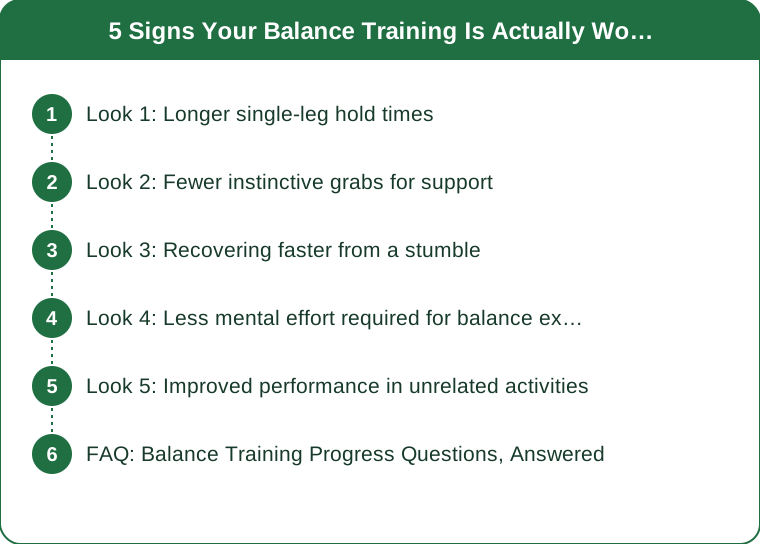
Look 1: Longer single-leg hold times
Time your single-leg stance (eyes open, then eyes closed if you’re more advanced) once a week, same time of day, same conditions. An extra 3-5 seconds week over week is genuine, measurable neurological adaptation — track the number, not the feeling.
Look 2: Fewer instinctive grabs for support
Notice how often your hand reaches for a wall, counter, or chair during daily activities that involve unstable footing — stepping into pants, reaching into a low cabinet. A decreasing frequency of these instinctive grabs is a strong real-world sign your balance system is adapting.
Look 3: Recovering faster from a stumble
The moment right after a minor trip or misstep — how quickly you regain stable footing — improves with balance training even before static balance tests show dramatic change, since this reflects your reactive balance system specifically, which responds to training differently than static holds.

Look 4: Less mental effort required for balance exercises
Early on, a balance exercise takes intense focus and concentration. As balance improves, the same exercise starts requiring noticeably less conscious effort — you can hold a conversation while doing it, for instance — even before the exercise gets objectively easier or longer.
Look 5: Improved performance in unrelated activities
Better balance often shows up first in activities that don’t look like “balance training” at all — steadier footing on stairs, more confidence on uneven sidewalks, easier transitions in and out of a car. These transfer effects are a genuine sign of improved proprioception, not a coincidence.
FAQ: Balance Training Progress Questions, Answered
How often should I test my balance to track progress?
Weekly is enough — testing more frequently can introduce more day-to-day variability (fatigue, distraction) than actual signal.
How long before balance training shows measurable improvement?
Most people see meaningful single-leg hold time improvement within 4-6 weeks of consistent practice, 2-3 times per week.
Is it normal for balance to feel like it’s not improving at all some weeks?
Yes — balance adaptation isn’t perfectly linear, and off weeks (often tied to fatigue or stress) are normal within an overall improving trend.
TL;DR:
- Track single-leg hold time weekly — small increases are real progress
- Fewer instinctive grabs for support during daily tasks is a genuine sign
- Faster recovery from a stumble reflects reactive balance improving
- Less mental effort required for the same exercise is progress, even before it gets easier
Keep Reading
This article is for general informational purposes only and is not medical advice. Always consult a qualified health professional for guidance specific to you.