5 Balance Drills You Can Do at the Kitchen Counter While Waiting on Coffee
Quick Answer: A kitchen counter provides a stable, always-available support for practicing single-leg stands, controlled weight shifts, and heel-to-toe balance work — five short drills done while coffee brews add up to meaningful balance practice without needing dedicated workout time.
Balance training often loses out to ‘no time,’ but a counter you’re already standing at for two minutes each morning is a genuinely underused training opportunity.

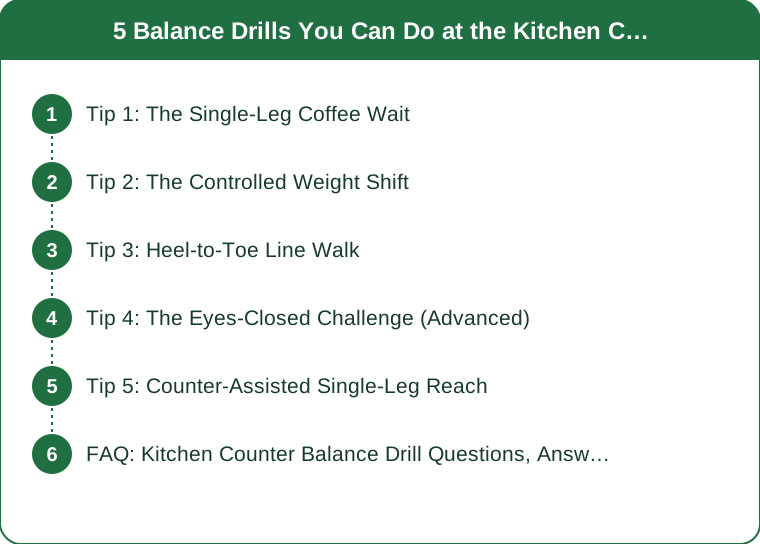
Tip 1: The Single-Leg Coffee Wait
Stand on one leg, lightly holding the counter for safety, for the time it takes coffee to brew (or aim for 30-60 seconds per side). Progress by reducing hand contact from a full grip to fingertips to no hands, as balance improves.
Switch legs each time you make coffee, alternating days if you make it more than once, to keep both sides progressing evenly.
Tip 2: The Controlled Weight Shift
Standing with feet hip-width apart, slowly shift weight fully onto one foot, hold 2-3 seconds, then shift to the other, using the counter for light support as needed. This trains the controlled weight transfer that’s actually behind most real-world balance recovery, more than static standing alone.
10-15 slow shifts, done consistently, build this control faster than most people expect from such a simple movement.
Tip 3: Heel-to-Toe Line Walk
Walk heel-to-toe along an imaginary line beside the counter, using it for light support only if needed. This narrow base of support challenges balance more directly than normal walking and translates well to uneven ground stability.
A few passes back and forth while waiting for toast is enough to make this a genuinely low-effort daily habit.

Tip 4: The Eyes-Closed Challenge (Advanced)
Once single-leg standing feels solid with eyes open, try 10-15 seconds with eyes closed, still near the counter for safety. Removing visual input forces the vestibular and proprioceptive systems to work harder, a meaningful progression once the basic version feels easy.
This should only be attempted once the eyes-open version is comfortable and stable — skipping ahead risks an unnecessary stumble.
Tip 5: Counter-Assisted Single-Leg Reach
Standing on one leg, reach the opposite hand toward the floor or toward the counter surface at an angle, using light counter support as a safety net. This adds a dynamic, functional element beyond static balance, closer to real-world movements like picking something up.
5-8 controlled reaches per side is enough to feel the difference from static balance work alone.
FAQ: Kitchen Counter Balance Drill Questions, Answered
How often should these drills be done to see improvement?
Daily, even for just a couple of minutes, tends to build noticeable improvement within a few weeks — consistency matters more than duration for balance-specific gains.
Is it safe to do these without any support at all?
Only once the supported version feels stable and controlled; the counter is there specifically as a safety net while balance capacity builds, not an optional extra.
Do these drills replace a dedicated balance training program?
They’re a strong low-effort addition and daily maintenance tool, but a more structured program adds value for anyone specifically working to improve balance for a health or fall-prevention goal.
TL;DR:
- A kitchen counter provides safe, always-available support for daily balance practice
- Single-leg stands, weight shifts, and heel-to-toe walks cover the basics in just a couple of minutes
- Progress by reducing hand support, then trying eyes-closed once the basic version is solid
- Daily consistency matters more than length of practice for balance-specific gains
The best balance training isn’t the session you have to schedule — it’s the one already built into time you’re standing there anyway.
Keep Reading
This article is for general informational purposes only and is not medical advice. Always consult a qualified health professional for guidance specific to you.