Five Balance Drills on the Stairs You Already Use Every Day
Quick Answer: Stairs demand single-leg control, precise foot placement, and a shift of weight over a changing base - the exact skills that decline first and that flat-floor balance drills do not train. Five short drills done on your own staircase, with a hand on or near the rail, cover all of it in under six minutes. Do them going up rather than down, keep every rep slow, and stop the moment control changes.
You probably do fifteen or twenty trips up and down your stairs a day without thinking about it. That is fifteen or twenty daily rehearsals of the exact movement pattern that matters most, being performed on autopilot.
Here are five ways to use two minutes of that deliberately.

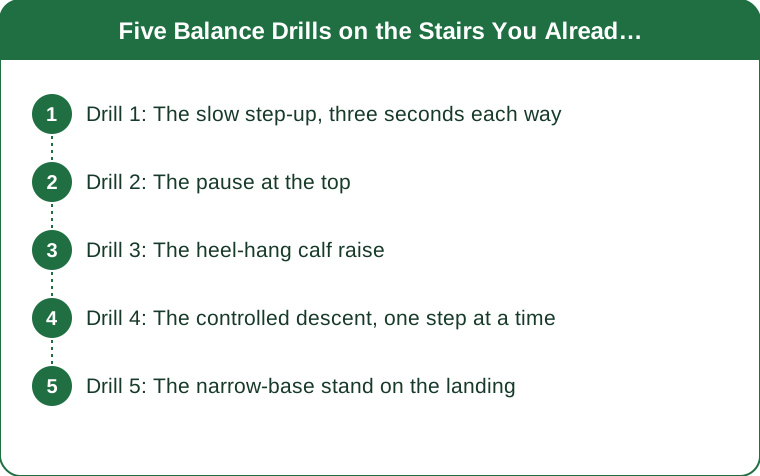
Drill 1: The slow step-up, three seconds each way
Place one whole foot on the first step, then take three full seconds to rise until you are standing on it, and three seconds to lower back down. Five reps each leg, hand resting lightly on the rail.
Slowness is the entire drill. A normal step-up takes under a second and uses momentum; taking three seconds removes momentum and forces the standing leg to control the whole movement, which is where the balance demand lives.
Watch the knee of the standing leg. If it drifts inward as you rise, that is the pattern to correct, and it is the same pattern that shows up in real stair use.
Keep the hand touching, not gripping. A light touch on the rail improves balance measurably through sensory feedback without doing the work for you - which means you are still training and still safe.
Build to eight reps per leg before making it harder, and make it harder by slowing down further, not by removing the hand.
Drill 2: The pause at the top
Step up normally, then stand still on that one foot for three to five seconds before bringing the other foot up. Five reps per leg.
This trains the moment where most stair stumbles actually happen - the single-leg support phase, where your entire body weight is on one foot on a narrow surface while the other leg is in transit.
Keep the free foot off the step, hovering near the ankle of the standing leg. Letting it touch anything converts this back into a two-leg exercise.
Look ahead, not down at your feet. Balance systems weight vision heavily, and looking down changes your head position, which changes the vestibular input. Training with your eyes forward is closer to how you actually use stairs.
If five seconds is easy on both legs, add a slow head turn - look left, then right, while holding. Head movement during single-leg support is a substantially harder task and a very relevant one.

Drill 3: The heel-hang calf raise
Stand on a step with the balls of your feet on the edge and your heels hanging off, both hands on the rail. Rise slowly onto your toes over two seconds, then lower until your heels are below the step level over three seconds. Eight to twelve reps.
This builds ankle strength through a full range, and the ankle is the first line of balance correction. Most small balance recoveries happen at the ankle before you are even conscious of them, and ankle strength and range both decline with age.
The lowering half matters more than the rising half. Take longer on the way down than the way up, always.
Both hands on the rail for this one. The heel-off-the-edge position is genuinely less stable and there is no benefit to making it more precarious.
Progress to one leg at a time only when twelve two-leg reps are comfortable, and expect the single-leg version to be dramatically harder - four or five reps is a normal starting point.
Drill 4: The controlled descent, one step at a time
Going down is where the risk sits, so train it deliberately: step down onto the lower step over three seconds, controlling the whole way, rather than dropping onto it. Five steps down, hand on rail, then walk back up normally.
Descending is eccentric work and it generates the highest joint forces in your daily routine. It is also the direction in which falls happen most, and the one nobody practises on purpose.
The cue that fixes most of it: land quietly. A noisy descent means you are dropping onto the step rather than lowering onto it. Aiming for silence recruits the control you are trying to build.
Do this on the bottom three or four steps only. There is no reason to practise a demanding descent at the top of a flight, and every reason not to.
Stop this drill the moment your legs feel tired. Fatigued eccentric control on stairs is precisely the condition you are training to avoid, and practising it in that state is counterproductive.
Drill 5: The narrow-base stand on the landing
On a flat landing next to the rail, stand with one foot directly in front of the other, heel to toe, for twenty to thirty seconds. Then swap feet.
This tandem stance narrows your base of support dramatically and is a standard clinical balance test, which makes it a useful benchmark as well as a drill. If you cannot hold it for ten seconds, that is worth knowing and worth working on.
Do it beside the rail, not in the middle of the landing. The whole point is to challenge balance, which means you should occasionally lose it, which means something should be within reach.
Progress by closing your eyes, not by lengthening the hold. Removing vision is a large step up and trains the vestibular and proprioceptive systems that matter most in the dark, on uneven ground, and at night.
Twenty seconds each side, twice, is enough. Balance responds to frequency rather than duration - short daily practice beats a long weekly session by a wide margin.
This is general information, not medical advice. If you have had a fall, feel dizzy, or have any condition affecting balance, speak to a physiotherapist or your doctor before starting stair-based exercises.
TL;DR:
- Stairs train single-leg control, foot placement, and weight transfer - the things flat-floor drills miss and the things that decline first.
- Slow step-ups at three seconds each way, then a three to five second pause at the top on one leg.
- Heel-hang calf raises build the ankle, which is where most unconscious balance corrections happen.
- Practise the descent deliberately on the bottom few steps only, and aim to land quietly.
- Finish with a tandem heel-to-toe stand on the landing - it doubles as a benchmark you can retest monthly.
Six minutes, on stairs you already use twenty times a day. Keep a hand near the rail throughout - a light touch improves balance without doing the work for you.
Keep Reading
This article is for general informational purposes only and is not medical advice. Always consult a qualified health professional for guidance specific to you.