Five Balance Drills for the Icy Season
Quick Answer: Winter falls are usually caused by an unexpected loss of footing that the body has no trained recovery for, not by poor static balance. The five drills below train reactive balance rather than the standing-still kind: narrow-stance eyes-closed holds, single-leg with head turns, the step-and-catch, heel-to-toe walking on an uneven surface, and the sit-to-stand without hands. Two sessions a week for eight weeks produces measurable change.
Standing on one leg for thirty seconds is the standard balance test and a poor predictor of whether you will stay upright on an icy pavement.
Ice does not test your ability to hold still. It tests whether your body can produce a fast, correct correction when the ground stops behaving as expected.
Five drills that train the second thing. Each has a progression, and the third one is the closest to what actually happens on ice.

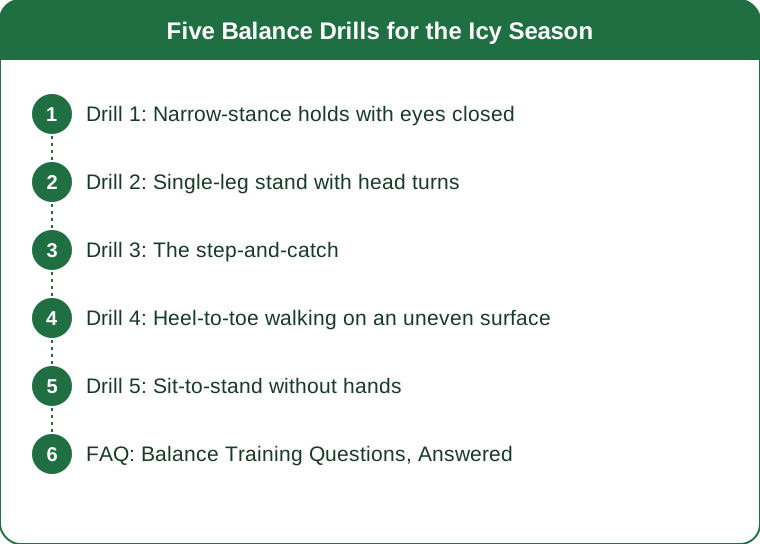
Drill 1: Narrow-stance holds with eyes closed
This one removes the input you rely on most, which forces the others to develop.
Stand with feet together, touching, next to a counter you can reach. Close your eyes. Hold for 30 seconds. That is the whole drill, and most people find it considerably harder than they expect.
Vision typically supplies a large share of balance information. Closing your eyes forces the inner ear and proprioception to do the work, and those are the systems that have to respond on ice — where you often cannot see the hazard anyway.
Progression, in order: feet together eyes open, feet together eyes closed, feet in a line (heel to toe) eyes open, heel to toe eyes closed. Move on when you can hold 30 seconds comfortably.
Always within arm’s reach of a solid surface. Not holding it — within reach of it. The point is to make corrections yourself and have a backup, and a counter is better than a chair, which can slide.
Three sets of 30 seconds, twice a week. It takes two minutes.
Drill 2: Single-leg stand with head turns
This adds the destabilising element that makes single-leg work transfer to real life.
Stand on one leg. Then slowly turn your head left and right, and then up and down, while maintaining the balance. Twenty seconds per leg.
The head turns matter because they disturb the vestibular system, and vestibular disturbance is exactly what happens when you slip, look down, or turn to check for traffic. A static single-leg hold with the head still trains a situation that rarely occurs.
This drill also has an unusually direct real-world application: many falls in older adults happen while turning, and head-turn balance work targets that specifically.
Progression: hold near a counter, then without touching, then with slower and larger head movements, then on a cushion or folded towel for an unstable surface.
If you feel dizzy, stop and reduce the speed of the head movement. Persistent dizziness with head movement is worth mentioning to a doctor rather than training through. This is general information, not medical advice.
Drill 3: The step-and-catch
This is the one that most directly resembles catching yourself, and it is missing from almost every home balance routine.
Stand relaxed. Let yourself lean forward from the ankles until you have to step forward to catch yourself. Take one decisive step, arrest the movement, and return to standing. Repeat ten times, then do it stepping sideways.
The reason this matters: recovering from a slip is a stepping task, not a holding task. The body’s primary fall-prevention strategy is a fast protective step, and that step gets slower and shorter with age and disuse.
Train it deliberately and the step gets faster and longer. This is one of the better-evidenced approaches in fall prevention, and it is essentially free.
Progression: small lean to larger lean, forward to sideways to backward — backward last, and only with a clear space behind you. Then add a slightly quicker release so the step has to be faster.
Do this with space around you and nothing to trip over. Not near stairs. If you live alone and are unsteady, do the first sessions with someone present.

Drill 4: Heel-to-toe walking on an uneven surface
This trains the ankle strategy, which is the first line of defence in a small slip.
Walk heel to toe in a straight line, ten steps, arms out. Then progress to doing it along a folded towel, a cushion, or a foam mat.
The uneven surface is what makes it work. On a firm floor, your ankles have a reliable reference. On an unstable surface they have to make continuous corrections, which is what develops the small stabilisers around the ankle joint.
Those muscles matter disproportionately in winter because the first correction in a small slip happens at the ankle — if it succeeds, nothing else is needed.
Progression: firm floor, then cushion, then eyes fixed on a point ahead rather than on your feet, then carrying something in one hand. Carrying is worth adding because winter falls very often happen with hands full or in pockets.
A note on pockets: hands in pockets in cold weather removes the arms from balance recovery entirely, and this is a genuine contributor to winter falls. Gloves rather than pockets is a real safety intervention.
Drill 5: Sit-to-stand without hands
The least glamorous drill and the one with the clearest relationship to independence.
Sit on a chair, feet flat, arms crossed over your chest. Stand up without using your hands, then sit down under control. Ten repetitions.
This is a strength drill as much as a balance drill, and that is deliberate — leg strength is what makes a balance correction possible. A perfect reactive strategy is useless if the leg cannot produce the force to execute it.
The controlled sitting-down half matters as much as standing up, and it is the half people rush. Take three seconds to lower.
Progression: higher chair to standard chair to lower chair, then to a single set from a low seat, then adding a small weight held at the chest.
Two to three sets, twice a week. If ten repetitions is easy, lower the chair rather than adding repetitions — this should be genuinely challenging by the last two.
Combined, these five drills take about fifteen minutes, twice a week. That is the whole programme, and eight weeks of it changes how the first icy morning goes.
FAQ: Balance Training Questions, Answered
How long until balance actually improves?
Measurable improvement typically appears within four to eight weeks of consistent twice-weekly training. Balance responds faster than most physical qualities, which makes it unusually rewarding to train.
Is it safe to train balance alone at home?
For most people, yes, provided you work within reach of a solid surface, clear the floor, and avoid the backward step drill until you are confident. If you have had a fall in the past year, feel unsteady daily, or have a condition affecting balance, start with a physiotherapist rather than alone.
Do balance boards and wobble cushions help?
They are useful for the ankle-strategy drills and less useful for reactive stepping, which needs open floor. A folded towel does most of what a cushion does. Buy equipment after eight weeks, not before.
TL;DR:
- Winter falls test reactive balance, not the standing-still kind — train the recovery, not the hold.
- Narrow stance with eyes closed builds the non-visual systems you need when you cannot see the hazard.
- Single-leg with head turns targets turning, where many falls actually happen.
- The step-and-catch trains the protective step directly, and it is missing from most routines.
- Heel-to-toe on an uneven surface develops the ankle correction that stops small slips.
- Sit-to-stand without hands provides the leg strength that makes every correction possible.
- Fifteen minutes, twice a week, eight weeks. Keep your hands out of your pockets in the cold.
You cannot train for the exact moment the pavement gives way. You can train the half-second afterwards, and that is the half-second that decides how it ends.
Keep Reading
This article is for general informational purposes only and is not medical advice. Always consult a qualified health professional for guidance specific to you.