Balance Exercises You Can Do at Home (No Equipment Needed)
Quick Answer: The most effective home balance exercises are single-leg stands, heel-to-toe walking, single-leg strength work, and eyes-closed challenges — all done near a wall or counter for support. Practice 5 minutes daily rather than 30 minutes weekly. Balance is a use-it-or-lose-it skill that declines without training, and it responds quickly at any age: most people notice improvement within 2–4 weeks.
Stand on one leg right now and start a timer.
Under 20 seconds? That’s worth knowing. Under 10 with your eyes closed is very common and also very trainable.
Balance is the fitness quality that declines most quietly, because nothing in your day tests it until the day something does.
Why Does Balance Matter More Than People Think?
Four reasons, and only one of them is falls.
1. It genuinely declines without use. Balance depends on three systems working together — the inner ear (vestibular), vision, and proprioception (your body’s position sense from joints and muscles). All three lose sensitivity with age, and proprioception in particular degrades when it isn’t challenged.
2. Falls are the headline risk, and it’s a big one. Falls are the leading cause of injury-related hospitalization in older adults, and balance training is among the most effective preventive interventions available. This matters well before you’d consider yourself old — the decline starts in the forties.
3. It underpins everything else you do. Every step you take is a controlled fall onto one leg. Every stair, every uneven pavement, every time you turn quickly. Better balance makes all of it more efficient and less effortful.
4. It’s the easiest quality to train at home. No equipment, no space, no clothes to change into. You can do it while brushing your teeth — which is genuinely the recommendation, not a joke.
And it’s never too early. Balance training at 35 is preventive maintenance on a system that will otherwise decline unnoticed for thirty years.
What Are the Best Home Balance Exercises?
Six, roughly in order of difficulty. Start where you’re stable and progress from there.
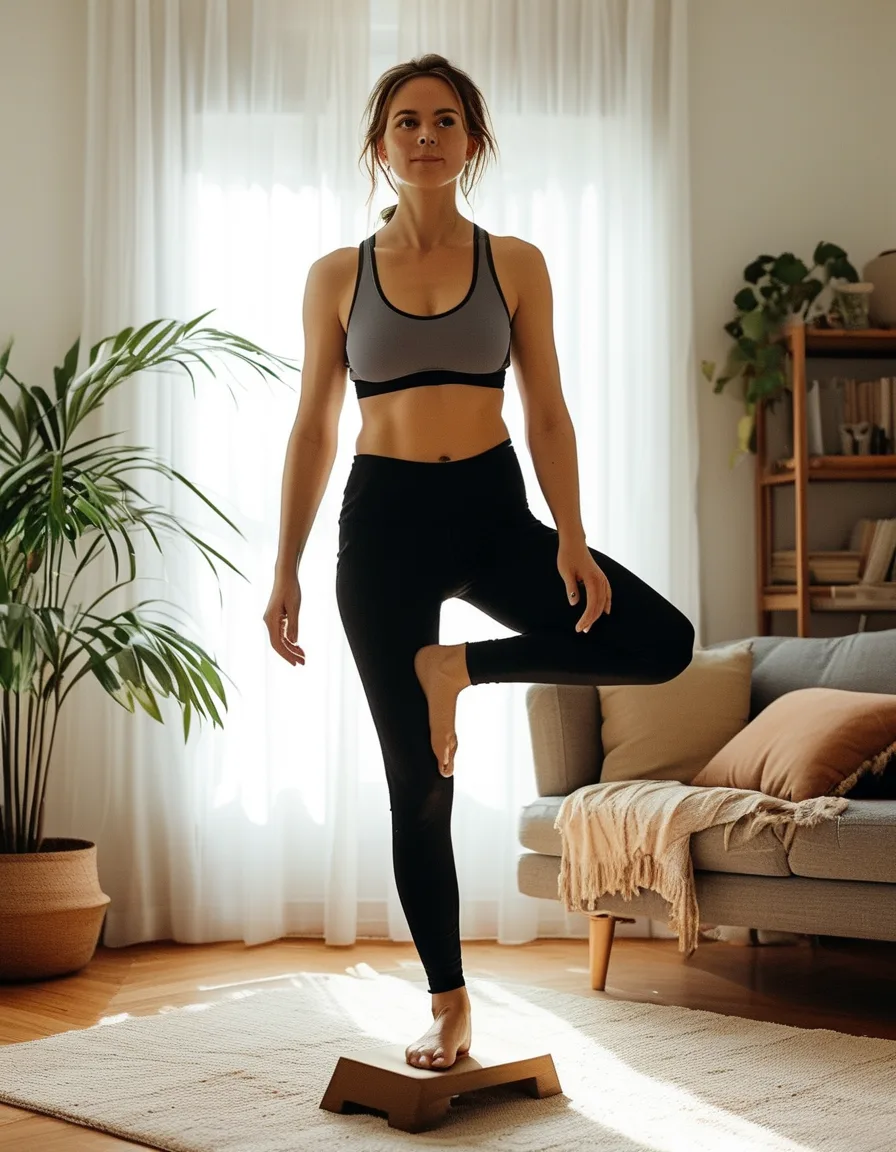
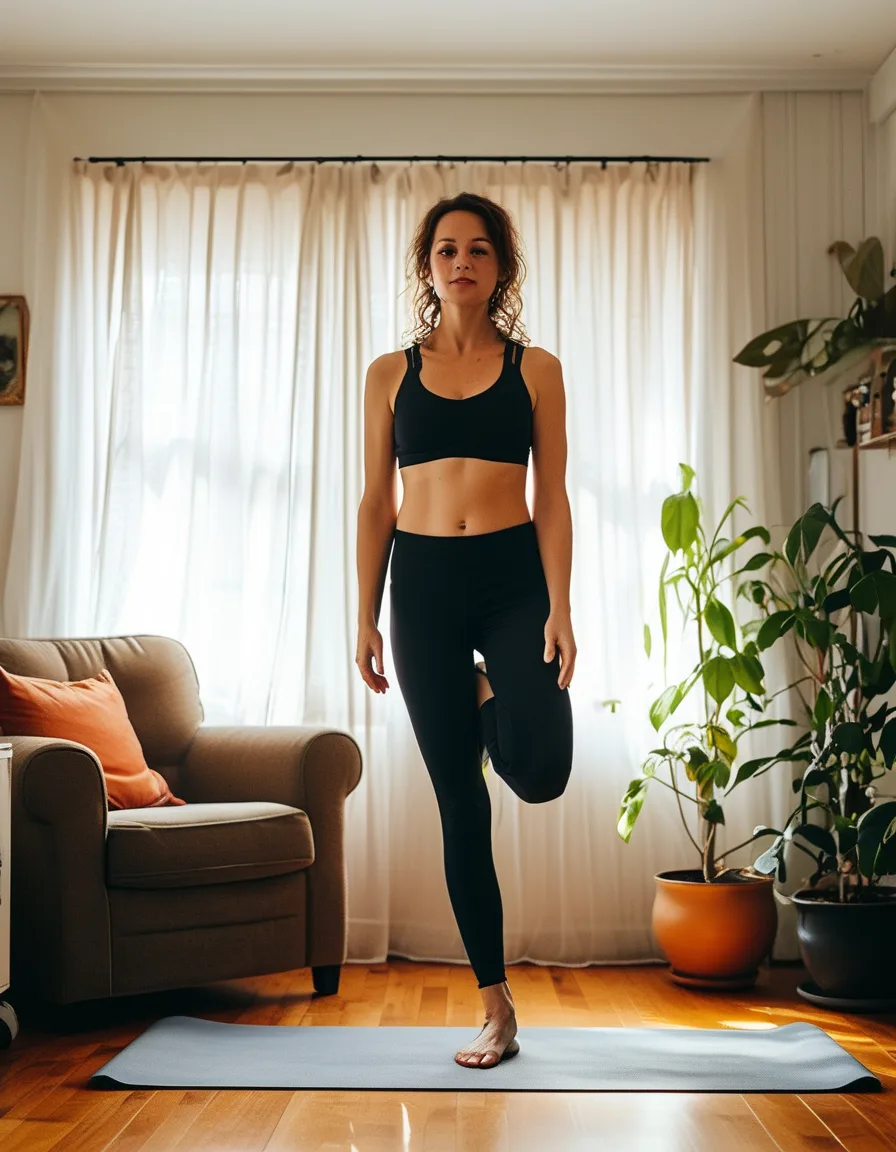
1. Single-leg stands. The foundation. Stand near a counter, lift one foot slightly off the floor, hold. Target: 30 seconds per leg. If you can’t reach 10 seconds, keep one or two fingers on the counter.
2. Heel-to-toe walking. Walk in a straight line placing the heel of one foot directly against the toes of the other. 20 steps forward, 20 back. Do it along a hallway where a wall is within reach.
3. Single-leg strength work. Balance isn’t only a sensory skill — it’s also the strength to correct yourself when you wobble. Single-leg glute bridges, step-ups onto a stair, and split squats all build it. 2 sets of 8 per side.
This is the piece most home routines skip, and it’s often what separates people who improve from people who plateau.
4. Proprioception challenges. Once single-leg stands are comfortable, remove vision: stand on one leg with eyes closed. This is dramatically harder because vision was doing more of the work than you realized. Target 10 seconds. Keep a hand near the wall.
Softer surfaces (a folded towel, a cushion) create a similar challenge with eyes open.
5. Head-movement (vestibular) work. Stand on one leg and slowly turn your head side to side, then up and down. This challenges the inner ear system specifically, which the other exercises largely bypass. 10 slow turns each direction.
6. Balance during daily tasks. Stand on one leg while brushing your teeth. While waiting for the kettle. While on a phone call. This is where the volume comes from, and it costs zero additional time.
Tai chi and yoga are both excellent structured options if you want a class-based approach — tai chi in particular has good evidence for fall reduction in older adults.
How Do You Progress Balance Training Safely?
Progression is where balance training goes wrong, because the failure mode is falling over.
The five levels, in order:
- Two feet together, eyes open
- Heel-to-toe stance, eyes open
- Single leg, eyes open, hand on support
- Single leg, eyes open, no support
- Single leg, eyes closed, hand near support
Only advance when the current level is comfortable for 30 seconds on both sides. Not “just achievable” — comfortable.
The safety rules, non-negotiable:
- Always practice within arm’s reach of a wall, counter, or sturdy chair. Not holding it — near it. Support available is different from support used.
- Clear the floor. No rugs, no pets underfoot, no obstacles behind you.
- Bare feet or grippy socks. Smooth socks on hard floors is how balance practice becomes a fall.
- Never practice eyes-closed work without a hand near support. Vision contributes far more to standing balance than people expect, and removing it produces sudden, large sways.
The frequency rule: 5 minutes daily beats 30 minutes weekly by a wide margin. Balance is a neural skill, and neural skills respond to frequency far more than to session length. Attaching it to teeth-brushing is the single most effective adherence strategy.
Find related balance exercises and vestibular work if you want to go deeper on either system.
What Nobody Tells You About Balance Training
- Your two sides will be noticeably different, and that’s diagnostic. A 15-second gap between legs is common and usually points to a strength or old-injury asymmetry worth addressing.
- Vision is doing most of the work. People are routinely shocked at how much harder eyes-closed balance is. That gap is the proprioceptive weakness the training targets.
- Improvement is fast at first, then slow. Most of the early gain is neural — your nervous system getting better at using signals it already had. Expect noticeable change in 2–4 weeks, then a longer, flatter curve.
- Strength matters as much as the sensory work. You can have excellent balance perception and still fall if your leg can’t produce force fast enough to correct. Single-leg strength is half the equation.
- Being tired or on certain medications changes your balance substantially. This is the one people don’t account for — balance is meaningfully worse when fatigued, dehydrated, or on medications that affect blood pressure or alertness. Test yourself when fresh, but remember that falls happen when you’re tired.
Frequently Asked Questions
How long should you be able to stand on one leg?
As a rough benchmark, adults under 60 should manage around 30 seconds per leg with eyes open, and 10 seconds with eyes closed. Under 40 has some association with fall risk in adults over 50. These are guides, not diagnoses — improvement over your own baseline matters more than any single number.
How often should you do balance exercises?
Daily, for about 5 minutes. Balance is a neural skill that responds to frequency far more than duration — five minutes every day produces substantially more improvement than one 30-minute session weekly. Embedding it in daily tasks like teeth-brushing is the easiest way to reach that frequency.
Can balance be improved at any age?
Yes. Balance training shows measurable improvement across all age groups, including adults in their eighties and nineties. The mechanisms — neural adaptation and strength gains — remain available throughout life. Progress may be slower with age, but the response is reliable.
Why is balancing with your eyes closed so much harder?
Because vision provides a large share of the information your brain uses to keep you upright. Remove it and your body must rely on the vestibular system and proprioception alone, both of which are less precise. Training eyes-closed specifically strengthens those two systems — which is exactly why it feels so difficult at first.
When to Check With a Professional
Sudden onset balance problems, dizziness, vertigo, or unsteadiness that appears over days or weeks needs medical assessment rather than exercise — those can indicate inner ear, neurological, or cardiovascular conditions that need diagnosis.
See your doctor if you’ve had a fall, if you feel unsteady walking on level ground, or if you’re on multiple medications (several common ones affect balance, and a medication review is often the highest-return intervention available). A physiotherapist can assess which of the three balance systems is limiting you and target the training accordingly, which is considerably more efficient than guessing.
This article is for general information and isn’t medical advice.
TL;DR:
- Balance is use-it-or-lose-it, declining from the forties onward, and falls are the leading injury risk it prevents.
- Core exercises: single-leg stands (30 sec target), heel-to-toe walking, single-leg strength, eyes-closed holds, head turns.
- Add single-leg strength work — balance is half perception and half the strength to correct a wobble.
- Five levels of progression. Only advance when the current one is comfortable for 30 seconds on both sides.
- Five minutes daily beats 30 minutes weekly. Always within arm’s reach of a counter, on a clear floor, in grippy socks or bare feet.
Keep Reading
This article is for general informational purposes only and is not medical advice. Always consult a qualified health professional for guidance specific to you.