Five Balance Setups for the Season When It's Dark at 6:30
Quick Answer: Balance depends on three inputs — vision, the inner ear, and sensation from your feet. Autumn degrades the first one for hours every day, which is why people feel less steady in October without having changed anything. The five setups below each train a different piece: eyes-closed work, unstable surfaces, walking turns, foot sensation, and a strength base. Ten minutes, three times a week, using furniture you already own.
Every year around now people notice they feel slightly less sure on their feet. On stairs, on a dark path, getting out of a car.
Nothing declined. The lighting did — and vision is doing far more of your balancing than you realize.
Setup 1: The Counter Drill (eyes open, then closed)
The foundational one, and the one that reveals how much you’ve been relying on your eyes.
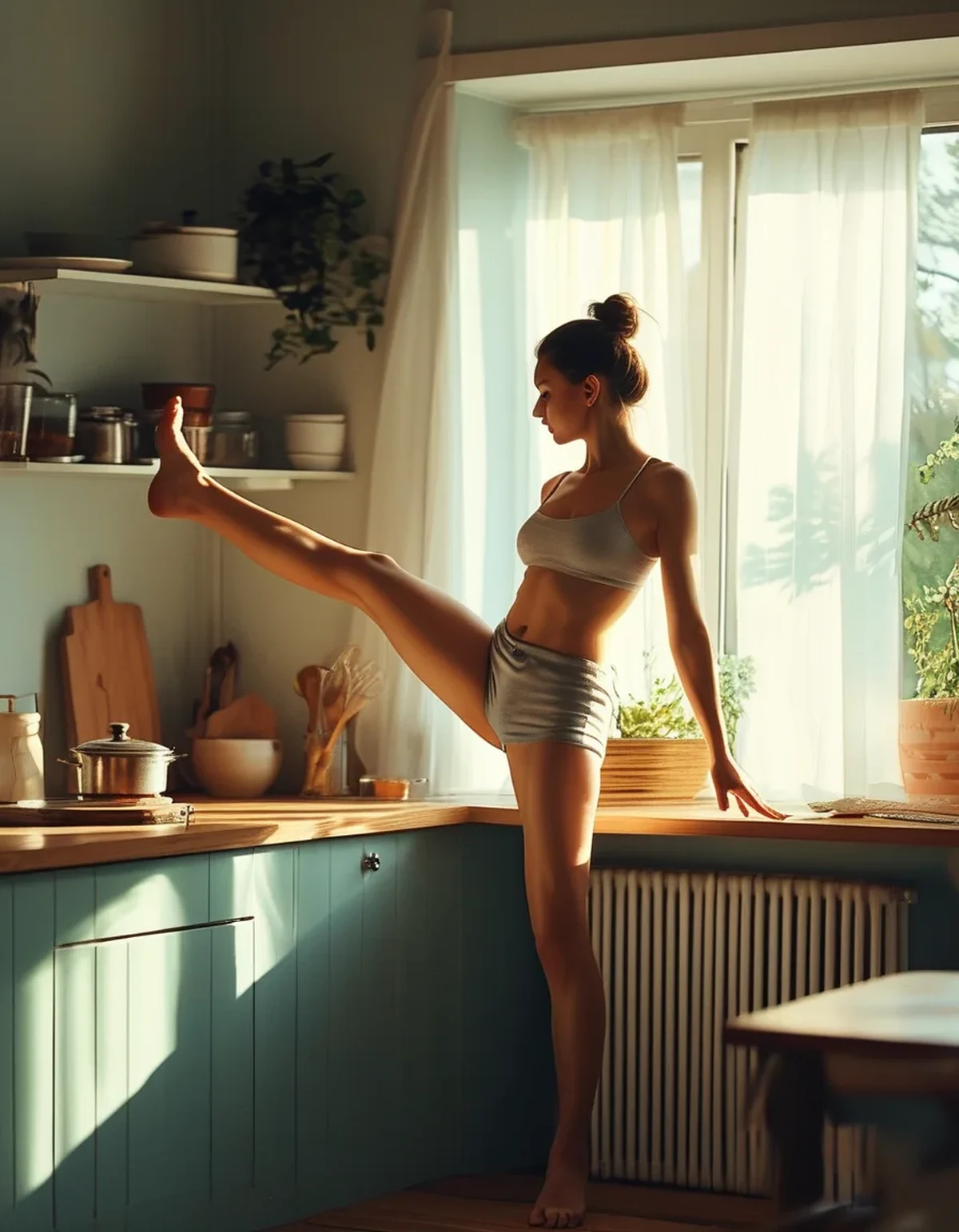
Where: at a kitchen counter, with both hands able to reach it. Not a chair back, which moves.
What to do:
- Stand on one leg, hands hovering above the counter but not touching. Hold 30 seconds per side.
- When that’s comfortable, do the same thing with your eyes closed. Hands closer to the counter now.
What you’ll notice: eyes-closed single-leg balance is dramatically harder — often the difference between 30 seconds and 5. That gap is the measure of how much of your balance is visual, and it’s exactly the capacity that autumn evenings take away.
Why this matters seasonally: at 6:30pm in October, walking to your car, you are operating closer to the eyes-closed condition than the eyes-open one. Training the eyes-closed version is training the actual situation.
Progression: 3 sets of 30 seconds per side, eyes open, then add closed-eye holds starting at 5 to 10 seconds. Do it while the kettle boils and it never needs to be a workout.
Setup 2: The Unstable Surface (a folded towel is enough)
You don’t need a balance pad. A folded bath towel on the floor does the same job.
Where: on a towel folded into quarters, near the counter.
What to do:
- Two-footed standing on the towel, 60 seconds, arms relaxed.
- Then single-leg on the towel, 20 to 30 seconds per side, hands near support.
- Then add a small movement — slow head turns left and right while balancing.
Why the head turns matter: turning your head challenges the vestibular system specifically, which is the input that doesn’t degrade with darkness and therefore the one worth training hardest. Most falls in real life happen while doing something else — reaching, turning, looking. Static balance with a still head is the easy version.
Why a soft surface: an unstable surface reduces the quality of information coming from your feet, forcing the other two systems to work harder. It’s the same principle as closing your eyes, applied to a different input.
The seasonal connection: wet leaves, uneven ground, and slick pavement are the real-world version of a towel, and they arrive in about four weeks.

Setup 3: Walking Turns and Direction Changes
Static balance is where people train. Dynamic balance is where people fall.
Where: a hallway or any clear stretch of six or eight steps.
What to do:
- Walk normally, then turn 180 degrees and walk back. Repeat ten times, alternating turn direction.
- Then heel-to-toe walking — each foot placed directly in front of the other, ten steps, using a wall for fingertip support if needed.
- Then walking with head turns: walk forward while looking left, then right, changing every two steps.
Why turning specifically: changing direction requires you to reposition your center of mass over a moving base while your vestibular system reports rotation. It’s genuinely the hardest thing you do on your feet, and it’s where a lot of stumbles happen — turning to grab something, turning at the top of stairs.
The realistic version: most people can do the straight-line walking easily and find the head-turn version surprisingly disorienting. That gap is the thing worth training.
Time: three minutes. Do it in the hallway on the way to something else.
Setup 4: Waking Up Your Feet
The most neglected input, and the one that changes fastest in autumn for a boring reason: shoes.
All summer you were barefoot or in minimal footwear a lot of the time, getting constant, rich sensory information from the soles of your feet. Then it gets cold, you put on thick socks and cushioned shoes, and that input drops significantly.
What to do, barefoot on a hard floor:
- Toe spreads — actively spread your toes apart and hold 3 seconds, 10 reps. Harder than it sounds.
- Short foot — without curling your toes, draw the ball of your foot slightly toward your heel to raise the arch. Hold 5 seconds, 10 reps per side.
- Rolling a ball under the arch for 60 seconds per foot. A tennis ball is fine.
- Barefoot single-leg stands, which combine this with setup 1.
Why it works: the sole of the foot is densely supplied with mechanoreceptors that tell your nervous system where you are relative to the ground. Better sensation means faster correction, and faster correction is what balance actually is.
Do it in the morning on a hard floor, not on carpet — you want the feedback. Two minutes.
Setup 5: The Strength Base (because balance is also strength)
The last setup isn’t balance training in the usual sense, and it’s the one with the most evidence behind it.
Staying upright when you’re pushed off balance requires the strength to catch yourself — a fast, powerful contraction from the hip and ankle. No amount of standing on one leg builds that if the underlying strength isn’t there.
Three exercises, twice a week:
- Sit-to-stands from a chair without using hands. 3 sets of 10. The single most functional lower-body movement there is, and progressable by lowering the chair.
- Step-ups onto a stair, controlled up and slow down. 2 sets of 8 per side. The slow lowering is the important half.
- Calf raises, ideally single-leg holding a counter. 2 sets of 12 per side. The ankle is your first line of balance correction and it’s usually the weakest link.
How this fits with the rest: setups 1 through 4 train the sensing and correcting. Setup 5 trains the ability to act on it. People who do only the balance drills often plateau because the limitation was never sensory.
Frequency for everything above: ten minutes, three times a week, is enough to produce measurable change in about six to eight weeks. Doing it now, before the ice arrives, is the entire point — balance training is preventive, and it takes weeks to work.
If you’ve had recent falls, dizziness, or a vestibular diagnosis, work with a physical therapist rather than self-programming. This is general information, not medical advice.
TL;DR:
- Balance runs on vision, inner ear, and foot sensation. Autumn removes hours of the first one every day.
- Counter drill: single-leg holds, then eyes closed. The gap between the two is how visually dependent you are.
- A folded towel is a balance pad. Add slow head turns to challenge the vestibular system.
- Turning is where people fall — practice 180-degree turns and walking with head turns.
- Wake your feet up barefoot on a hard floor; thick socks and cushioned shoes cut your sensory input.
- Strength is half of balance — sit-to-stands, step-ups, and single-leg calf raises twice a week.
Ten minutes, three times a week, starting now. It takes six to eight weeks to work, and the ice arrives in twelve.
Keep Reading
This article is for general informational purposes only and is not medical advice. Always consult a qualified health professional for guidance specific to you.