5 Balance Drills You Can Do While Brushing Your Teeth
Quick Answer: Balance is a nervous system skill, which means brief daily practice beats long weekly sessions. Two minutes at the sink covers five progressive drills - single-leg stand, heel-to-toe stand, head turns, eyes closed, and heel raises - each with a counter within reach. Most people notice a difference within three to four weeks.
The reason balance training fails is almost never the exercises. It is that nobody sets aside a session for it, so it never happens.

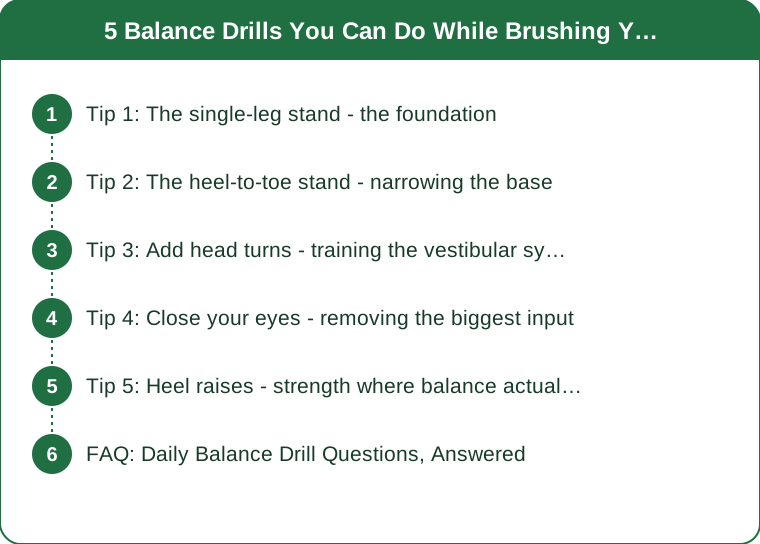
Tip 1: The single-leg stand - the foundation
Everything else builds on this one, and it is the best single measure of where you are.
How to do it: stand at the sink, hands hovering near the counter but not touching. Lift one foot a few inches off the floor, knee slightly bent. Hold. Swap sides halfway through brushing.
What to aim for: work up to 30 seconds per side comfortably. If you cannot manage 10 seconds, keep one or two fingers on the counter and reduce the contact over the weeks.
Where people go wrong:
- Holding the counter tightly. That trains your arm. Fingertips only, and ideally hovering.
- Looking down at the floor. Looking down narrows the visual field and, oddly, makes balance harder. Look at a fixed point ahead - the mirror is right there.
- Locking the standing knee. A soft knee lets the ankle and hip make the constant micro-adjustments that balance depends on.
Why it works so well as a daily drill: it is genuinely the most transferable balance skill, because almost every step you take is briefly a single-leg stand. Improving it improves walking, stairs, and stepping over things, which is the whole point.
Tip 2: The heel-to-toe stand - narrowing the base
Once single-leg is comfortable, this is the next progression, and it targets side-to-side control specifically.
How to do it: place one foot directly in front of the other, heel touching toe, as though standing on a line. Hands near the counter. Hold 30 seconds, then swap which foot is in front.
Why it is harder than it looks: narrowing your base of support to almost nothing side to side removes the widened stance most people have unconsciously adopted. This drill directly retrains the habit of standing wider for stability.
Progressions, in order:
- Heel-to-toe with fingertips on the counter
- Heel-to-toe with hands hovering
- Heel-to-toe with arms crossed over your chest
- Heel-to-toe on a folded towel
A useful check: if you sway a lot side to side, your hip stabilisers are the limiter. If you sway forward and back, it is more ankle. Both improve with the drill, but noticing which tells you what else might help - side-lying leg raises for the hips, calf and shin work for the ankles.
Do this one while the toothbrush timer runs and you will get a solid 30 seconds per side without thinking about it.
Tip 3: Add head turns - training the vestibular system
This is the drill that addresses the wobble people feel when they look up at a shelf or turn quickly toward a voice.
How to do it: stand in a narrow stance or heel-to-toe, hands near the counter. Slowly turn your head to look left, then right, then back to centre. Then nod slowly up and down. Keep the movements slow and controlled.
Why it matters: the inner ear detects head movement, and it has to coordinate with vision and with sensation from your feet. That coordination degrades with age and with reduced activity, and it is the specific system responsible for feeling unsteady during head movement.
Progression:
- Head turns in a normal stance
- Head turns in a narrow stance
- Head turns on one leg
- Head turns with slightly quicker movements
Important caution: if head turns cause genuine spinning, nausea, or a sense of the room moving, stop and see a healthcare professional. That is a different problem from mild unsteadiness, and it often has a specific and very treatable cause. Mild wobbliness is what you are training; vertigo is not. This is general information, not medical advice.

Tip 4: Close your eyes - removing the biggest input
Vision does an enormous amount of the work in balance, which becomes obvious the moment you remove it.
How to do it: feet together, hands near the counter, eyes closed. Hold 20 to 30 seconds. Only progress to a narrower stance or one leg when this is genuinely steady.
Why it is worth doing: when vision is removed, your system has to rely on the inner ear and on sensation from the feet and joints. Training without vision strengthens the inputs you will need in the dark, which is when a large share of falls happen - getting up at night, a dim hallway, a poorly lit stair.
Safety first, genuinely. This is the one drill where the counter matters. Stand close enough to touch it instantly. Do not do this one first thing when you are still groggy.
Progression:
- Eyes closed, feet hip-width
- Eyes closed, feet together
- Eyes closed, heel-to-toe
- Eyes closed, one leg - advanced, and only with a solid support within reach
A note on what you will notice: almost everyone sways considerably more with eyes closed, and the amount reduces quickly with practice. That fast improvement is the nervous system learning to weight its other inputs more heavily.
Tip 5: Heel raises - strength where balance actually lives
The fifth drill is strength rather than balance, and it belongs here because ankle strength is what balance runs on.
How to do it: stand facing the sink, fingertips on the counter. Rise onto the balls of your feet, hold for two seconds at the top, and lower slowly over three seconds. The slow lowering is where most of the benefit is. Aim for 12 to 15 repetitions.
Why the calf matters so much: the calf and ankle control the small forward-and-back sway that happens constantly while standing. Weak ankles mean your body has to correct with bigger, later movements - a step instead of a sway - and that is the difference between a wobble and a stumble.
Progression:
- Both legs, fingertips on the counter
- Both legs, hands hovering
- Single leg, fingertips on the counter
- Single leg, hands hovering
Pair it with the toe raise - lifting the toes off the floor while the heels stay down, 12 to 15 reps. That trains the front of the shin, which lifts your foot during walking. Weakness there is a very common cause of catching a toe on a step, and it takes twenty seconds to train.
Between the calf and shin work, you have covered both directions of ankle control in under a minute.
FAQ: Daily Balance Drill Questions, Answered
How long before I notice a difference?
Most people notice improvement in three to four weeks of daily practice. Balance adapts largely through nervous system learning, which is faster than the tissue changes strength training depends on.
Is two minutes a day really enough?
For maintenance and steady improvement, yes - frequency matters more than duration for this. If you want faster progress, add a second two-minute slot rather than making one session longer.
Should I do these barefoot or in shoes?
Barefoot is generally better for these drills, since it lets your feet sense the floor directly and trains the small foot muscles. A bathroom floor after a shower is slippery, though - dry feet and a dry floor first.
What if I cannot do any of them without holding on?
Start holding on, with the goal of reducing contact over weeks - two hands, then one, then fingertips, then hovering. Holding on and practising beats not practising, every time.
When should I be concerned rather than just training?
Any fall, an unexplained near-fall, spinning sensations, new numbness in the feet, or a sudden change in balance all warrant a professional opinion rather than a home routine. This is general information, not medical advice.
TL;DR:
- Balance is a nervous system skill - brief daily practice beats long weekly sessions
- Single-leg stand is the foundation; aim for 30 seconds per side with hands hovering
- Heel-to-toe narrows your base and retrains the widened stance habit
- Head turns train the vestibular system; eyes closed trains the inputs you need in the dark
- Heel and toe raises build the ankle strength balance actually runs on
The reason this works is not that the drills are special. It is that the sink is somewhere you already stand twice a day, so the practice happens without needing a decision. Attach it to the toothbrush and in a month you will have done sixty sessions you would otherwise never have started. This is general information, not medical advice.
Keep Reading
This article is for general informational purposes only and is not medical advice. Always consult a qualified health professional for guidance specific to you.