Five Balance Drills for Wet Leaves and Slippery Ground
Quick Answer: A slippery surface removes the friction your balance strategy assumes, so the useful skills are different: shorter steps, foot landing more flat than heel-first, weight staying over your base, and the ability to recover when a foot moves unexpectedly. These five drills train the specific reactions a slick surface demands, and all of them can be done at home before you need them outdoors.
The pavement looks the same as it did in August. Under a layer of wet leaves on a gentle slope, it is a completely different problem, and the first time you find that out should not be at speed.

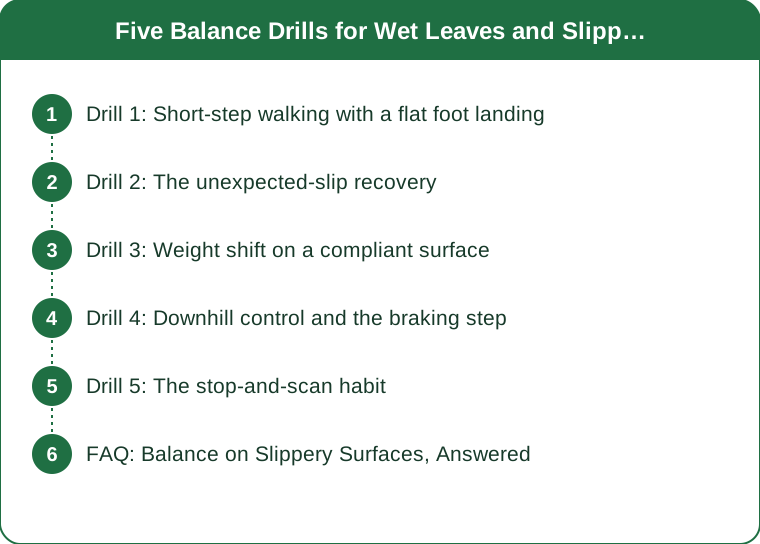
Drill 1: Short-step walking with a flat foot landing
Practise walking with steps about two-thirds of your normal length, landing with the foot flatter rather than striking hard with the heel. Twenty metres, three times, in a hallway or garden.
Why this specific pattern: a heel strike on a slippery surface presents a small contact area at an angle, which is where slips begin. A flatter landing puts more of the sole down at once and directs force more vertically, both of which increase available grip.
Shorter steps keep your centre of mass closer to your base. The longer the step, the further forward your body travels ahead of your support foot, and the less recoverable a slip becomes.
Add the arms deliberately. Hands out of pockets, arms free to move. Arms are a genuine balance mechanism and pockets remove them - one of the most common contributors to autumn and winter falls, and one of the easiest to fix.
Practise it enough that it is available automatically. The point is not to walk like this all the time, but for the pattern to be there when you step onto something slick, without needing to decide.
Drill 2: The unexpected-slip recovery
Stand on a folded towel on a smooth floor, near a counter you can reach. Shift weight onto it and let it slide slightly, then recover. Five slow repetitions each side.
Why it works: a slip is a rapid unexpected displacement of one foot, and the recovery is a reflex that improves with practice. Perturbation training - deliberately introducing small controlled disturbances - has good evidence for reducing falls in older adults, and this is a simple home version.
Keep it small and controlled. The aim is to experience a foot moving and to practise responding, not to actually fall. Stay within reach of a support, and stop if it feels genuinely unstable.
Notice what your body does. Most people find the recovery comes from a quick step and an arm swing rather than from stiffening. Stiffening is the instinct that makes slips worse, and feeling the difference in a safe setting is the point.
Two sessions a week is plenty. This is a skill drill, not a conditioning one, and it does not need volume - if you have any history of falls or significant balance problems, do it with someone present or ask a physiotherapist to supervise first.
Drill 3: Weight shift on a compliant surface
Stand on a folded blanket, a cushion, or a balance pad, feet hip-width apart. Slowly shift weight forward, back, and side to side to the edge of your control, then return. Two minutes.
Why a soft surface: it reduces the reliability of the sensory information from your feet, which forces your ankles and hips to work harder at controlling position - the same demand created by an uncertain surface outdoors.
Go slowly and go to the edge. The value is in the range of control, not in speed. Moving to the point where you nearly need to step, then coming back, is where the training happens.
Progress by narrowing the base, bringing the feet closer together, and eventually to a staggered stance. Add eyes closed only once the open-eyed version is comfortable, and only with a counter within reach.
Barefoot is better here. Direct contact gives your foot better information, and the small muscles of the foot are part of what you are training. On a slippery outdoor surface, that foot awareness is exactly what tells you the ground has changed.

Drill 4: Downhill control and the braking step
Practise walking down a gentle slope or a few stairs slowly, with control, keeping your weight over your feet rather than leaning back. Ten repetitions, holding a rail.
Downhill on a slick surface is where most autumn slips happen. Gravity is pulling you forward, the surface is not gripping, and the instinct is to lean back - which reduces contact pressure on the front foot and makes the slip more likely, not less.
The correct pattern is staying upright over your feet with slightly bent knees, taking short steps, and letting the leg muscles do the braking. This is eccentric quadriceps control, and it is the same capacity that makes stairs manageable.
Practise the traverse too. On a genuinely slippery slope, going down at an angle rather than straight is more stable, and it is worth having done it deliberately once rather than working it out mid-descent.
And if there is a rail, a fence, or a wall outdoors, use it. Using support on a slick descent is good judgement, not caution - the aim is to arrive at the bottom, and there are no marks for style.
Drill 5: The stop-and-scan habit
This one is cognitive rather than physical, and it may matter most. Practise deliberately stopping at the transition between two surface types - dry path to wet leaves, pavement to grass, outside to a wet entrance floor - and looking before continuing.
Transitions are where falls cluster. Your gait is calibrated to the surface you are on, and it takes a step or two to recalibrate. A brief pause at the boundary lets you adjust before the surface has already changed under you.
Train yourself to read the surface. Wet leaves on stone are considerably more slippery than wet leaves on soil. Painted lines, metal covers, and smooth tiles are all far slicker wet than the surfaces around them. Shaded patches stay wet and icy longest.
Deal with the footwear at the same time. Worn tread is a genuine and very common contributor, and the sole is worth checking at the start of autumn - if the pattern is smooth in the middle, the grip has gone regardless of how the shoe looks otherwise.
And handle what you carry. Two full bags remove your arms from the balance system and shift your centre of mass unpredictably. One bag across the body, hands free, is meaningfully safer on a slick day.
A general note: if you have had a fall, feel unsteady regularly, or notice balance changing, that is worth raising with a doctor or physiotherapist rather than only training around it - medication side effects, vision changes, and inner ear problems are all common and treatable contributors. This is general information, not medical advice.
FAQ: Balance on Slippery Surfaces, Answered
How do you walk safely on wet leaves?
Shorten your steps to about two-thirds of normal, land with a flatter foot rather than a hard heel strike, keep your weight over your base, and take your hands out of your pockets so your arms can help. Pause at the transition onto the leaves rather than walking straight from dry ground.
Can balance training reduce slips and falls?
Yes - balance and perturbation training have good evidence for reducing falls, particularly in older adults. Practising controlled recoveries from small unexpected movements trains the specific reflex a slip requires, which general strength work does not.
Why are wet leaves so slippery?
A wet leaf layer separates your shoe from the surface underneath and provides very little friction itself, and decomposing leaves become slick and mobile. On stone or paving the effect is far worse than on soil, and shaded areas stay wet longest.
What footwear is best for slippery autumn ground?
A sole with a deep, open tread pattern that clears debris, and a softer rubber compound, which grips better in the cold and wet than a hard one. Check the middle of your existing soles - if the pattern has worn smooth there, the grip has gone even if the shoe looks fine.
TL;DR:
- A slippery surface removes the friction your normal gait assumes, so the useful skills are different ones.
- Drill 1: short steps with a flatter foot landing, arms free and out of pockets.
- Drill 2: controlled slip recovery on a folded towel near a counter - perturbation practice has real evidence behind it.
- Drill 3: slow weight shifts on a cushion or folded blanket, barefoot, progressing to a narrower base.
- Drill 4: downhill control with weight over the feet and knees soft - leaning back makes slips more likely, not less.
- Drill 5: stop and scan at surface transitions, where falls cluster, and check your tread at the start of the season.
- One cross-body bag beats two handfuls; your arms are part of the balance system.
If you feel unsteady regularly or have had a fall, get it assessed - vision, medication, and inner ear causes are common and treatable. This is general information, not medical advice.
Keep Reading
This article is for general informational purposes only and is not medical advice. Always consult a qualified health professional for guidance specific to you.