5 Balance Drills That Prepare You for Stairs and Uneven Ground
Quick Answer: Real-world balance failures happen on changing surfaces and during transitions, not while standing still. Train step-downs, single-leg stance with head movement, uneven surface stance, tandem walking, and controlled reaching - all of which target the specific demands of stairs and uneven ground. Five drills, about ten minutes, three times a week.
Standing on one leg for 30 seconds is a genuinely useful test. It just isn’t the situation in which most people lose their balance. Falls happen mid-step, on a surface that changed, while looking at something else.
This is general information, not medical advice. If you have had a fall, or feel unsteady frequently, a clinician or physiotherapist should assess you - some causes are medical rather than muscular.

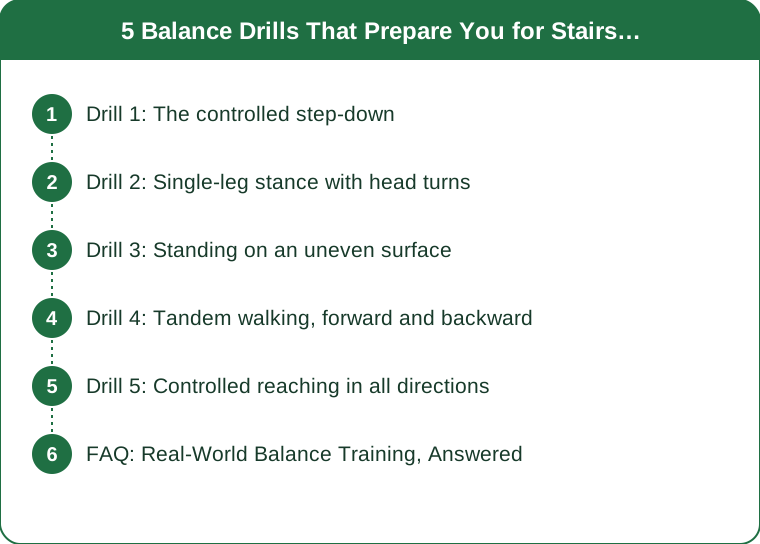
Drill 1: The controlled step-down
Why it matters: descending stairs is one of the highest-risk everyday activities, and it demands eccentric control - lowering your body weight slowly on one leg. Nothing about standing still trains this.
How to do it:
- Stand on a step or a sturdy low platform, 10-20cm to start
- Hand near a rail but not gripping it
- Slowly lower one heel toward the floor over 3 seconds, tapping lightly without transferring weight
- Return to the top over 2 seconds
- 8 repetitions per leg, 2 sets
What to watch for: the knee of the standing leg drifting inward, and the hip dropping on the lowering side. Both indicate the glute medius isn’t holding, and that’s exactly the muscle that fails on stairs.
Progression: increase step height to 20cm, then remove the hand from near the rail, then slow the lowering to 5 seconds.
Regression if it’s too hard: use a lower step, or lower with both hands lightly on a rail. Do not skip this drill because it’s difficult - the difficulty is the reason it’s first on the list.
Drill 2: Single-leg stance with head turns
Why it matters: you rarely balance while staring at a fixed point. You balance while looking at traffic, at a handrail, at where you’re going. Head movement disrupts the vestibular input your balance depends on, and training it is what makes balance robust rather than fragile.
How to do it:
- Stand on one leg near a wall or counter
- Once stable, turn your head slowly left and right, 10 turns
- Then up and down, 10 movements
- 2 sets per leg
What most people find: balance that felt solid becomes noticeably harder. That gap is precisely the deficit worth training.
Progression order - one change at a time:
- Head turns with eyes open
- Head turns while tracking a moving hand
- Eyes closed, no head movement - this is a big jump, do it near support
- Both, if you’re confident
Safety note: if head movement produces dizziness, spinning, or nausea, stop and mention it to a clinician - that’s a vestibular symptom rather than a balance weakness, and it’s treatable.
Drill 3: Standing on an uneven surface
Why it matters: gravel, grass, tree roots, and uneven paving all present a surface that moves or slopes unpredictably. Ankles need to respond faster than conscious thought, and that reflex is trainable.
How to do it:
- Use a folded thick towel, a cushion, or a pillow on the floor - no equipment purchase needed
- Stand on it with both feet, 60 seconds
- Progress to single leg, 20-30 seconds per side
- 2 sets
What it trains: the peroneal muscles at the outside of the lower leg, which are what stop an ankle rolling, plus the ankle proprioceptors that detect position change.
Progression:
- Both feet on a firm cushion → both feet on a softer one
- Single leg on firm → single leg on soft
- Add small arm movements, then head turns
- Outdoors on actual grass or gravel, near support
The seasonal point: wet leaves in autumn are one of the most common slip surfaces of the year, and they combine an unstable surface with reduced friction. This drill is worth increasing in September and October specifically.

Drill 4: Tandem walking, forward and backward
Why it matters: narrow-base walking is what a kerb, a garden path, or a stepping-stone route demands. It also trains the weight transfer that happens with every single step - the moment when you’re briefly on one leg and moving.
How to do it:
- Walk heel-to-toe in a straight line, as though on a tightrope, 10 steps
- Turn around and walk back 10 steps
- Then walk backward heel-to-toe, 10 steps - considerably harder
- 2 sets of the full sequence
Where to do it: along a hallway with a wall within reach on one side. Not in an open room - the wall is what makes this safe to attempt properly.
What to watch: looking down at your feet. Look ahead at a point on the wall instead. Looking down is what people do on real uneven ground and it’s part of why they lose balance - it changes head position and shortens your view of what’s coming.
Progression: slow it down rather than speeding it up. A slow tandem walk is much harder than a quick one, because there’s more time on each single-leg phase.
Drill 5: Controlled reaching in all directions
Why it matters: most balance loss happens while doing something - reaching for a handrail, picking something up, putting a bag down. Balance that only works when you’re standing still isn’t much use.
How to do it:
- Stand on one leg, near a counter
- Reach the opposite hand forward as far as you can control, and return
- Then reach across your body to the far side
- Then reach down toward the floor and back up
- 5 reaches in each of the three directions, per leg
The key instruction: reach only as far as you can return from under control. The point isn’t maximum reach - it’s controlled recovery, which is the actual skill that prevents a fall.
Progression: hold a light weight (1-2kg) in the reaching hand, or reach to touch a marker on the floor.
How to track progress: mark the furthest point you can reach and return from, on the floor with tape, for the forward direction. Re-measure monthly. This is one of the few balance measures you can see improve numerically, which matters enormously for staying motivated - most balance training gives you no feedback at all.
Putting it together: all five drills take about ten minutes. Three sessions a week is the effective dose, and most people notice stairs feeling more secure within three to four weeks.
FAQ: Real-World Balance Training, Answered
Do I need a balance board or wobble cushion?
No. A folded towel or a sofa cushion does the same job for these drills. Balance boards are useful later and are not a starting requirement.
How long before I notice a difference?
Most people report stairs and kerbs feeling more secure within three to four weeks of three sessions a week. Measurable single-leg stance time usually improves within two.
Is it safe to train balance alone?
With support within arm’s reach, yes - and that’s the standard instruction. If you’ve had a fall or feel unsteady frequently, do the first few sessions with someone present and get a clinician’s assessment.
Should I hold on or not?
Hold lightly only as much as you need. Balance training works by challenging the system, so gripping firmly removes the stimulus. Fingertips resting on a counter is the ideal middle ground - support available, challenge intact.
TL;DR:
- Real falls happen mid-transition on changing surfaces, not while standing still
- Step-downs train the eccentric control that stairs actually demand
- Add head turns to single-leg stance - fixed-gaze balance is fragile balance
- A folded towel is all the uneven-surface equipment you need
- Tandem walking backward is harder and more useful than forward
- Controlled reaching trains recovery, which is the skill that prevents a fall
Ten minutes, three times a week, no equipment. Stairs and kerbs feel different within a month - and those are the surfaces where it actually counts.
Keep Reading
This article is for general informational purposes only and is not medical advice. Always consult a qualified health professional for guidance specific to you.