5 Balance Drills for the Move That Catches People Out: Getting Out of a Car
Quick Answer: Getting out of a car stacks four demands that balance training usually practices separately: rising from a low seat, rotating the torso, briefly loading one leg, and stepping onto a surface that is often uneven or higher than expected. Five drills train the combination directly - a low-seat sit-to-stand, a seated pivot, a step-up to an uneven surface, a single-leg weight shift with support, and a loaded version carrying a bag. Practice at home where a wobble costs nothing, and the real thing gets noticeably easier within a few weeks.
Everything else is fine. Then you park somewhere unfamiliar, the kerb is higher than you expected, you are holding a bag, and the whole sequence goes wrong in a way that stays with you for a week.

Drill 1: The low-seat sit-to-stand
Rising from a low seat is the foundation, and car seats are low. A dining chair is too tall to be a realistic rehearsal for most cars - use a lower chair, a sofa, or a chair with a cushion removed to get closer to car seat height.
Practice standing without pushing off with your hands. Feet flat and slightly back, lean the chest forward over the knees, then drive up through the whole foot. Hands come to the thighs only if needed. The hand-free version is the goal, not the requirement.
Do 8 to 10 controlled repetitions, twice through. Slow down the sitting phase - lowering with control is where most of the strength benefit is, and it is also the part that fails first.
Have something stable within reach. A counter, a sturdy chair back, or a wall. The point of home practice is that support is available and a wobble is a non-event.
Progress by lowering the seat. As it gets easier, add a lower surface. When you can rise from a genuinely low seat with control and without hands, the car version stops being a challenge.
Drill 2: The seated pivot
Getting out of a car is a rotation before it is a stand, and rotating on a seat while keeping the knees together is a skill in itself.
Sit on the edge of a chair with knees and feet together. Lift slightly through the hips and rotate 90 degrees to face sideways, then rotate back. Five each direction, slowly.
Keep the knees together throughout. This is the technique that protects hips and knees during the real transfer, and it is the part most people skip when they twist out of a car one leg at a time.
Add a smooth surface to practice on. A folded plastic bag or a satin cushion cover under the hips replicates the seat covers many people use in cars for exactly this reason, and it teaches you how much easier the movement is with reduced friction.
Then combine drill 1 and drill 2. Pivot to face sideways, feet flat, then stand. That two-part sequence is the actual movement, and practicing it as a unit is what transfers to the car park.
Drill 3: The step-up to an uneven surface
The kerb is where the surprise happens. Stepping from a road surface up onto a kerb of unknown height, immediately after standing, is the highest-risk moment in the whole sequence.
Practice stepping up onto a low step or a sturdy book stack, with a hand near a support. Step up, pause for two seconds with the weight fully on the stepping leg, then step down with control.
Vary the height between sessions. Predictable practice builds predictable balance. Alternating between a low step and a slightly higher one trains the adjustment that the real world demands.
Practice stepping up with each leg leading. Most people have a strong preference and a much weaker non-preferred side, and the car park does not always let you choose.
Add a head turn at the top. Turning to look for traffic while standing on one leg on a kerb is the actual task, and head movement genuinely challenges balance because it disrupts vestibular input. Building it in deliberately is far better than meeting it for the first time on a road.
Drill 4: The single-leg weight shift
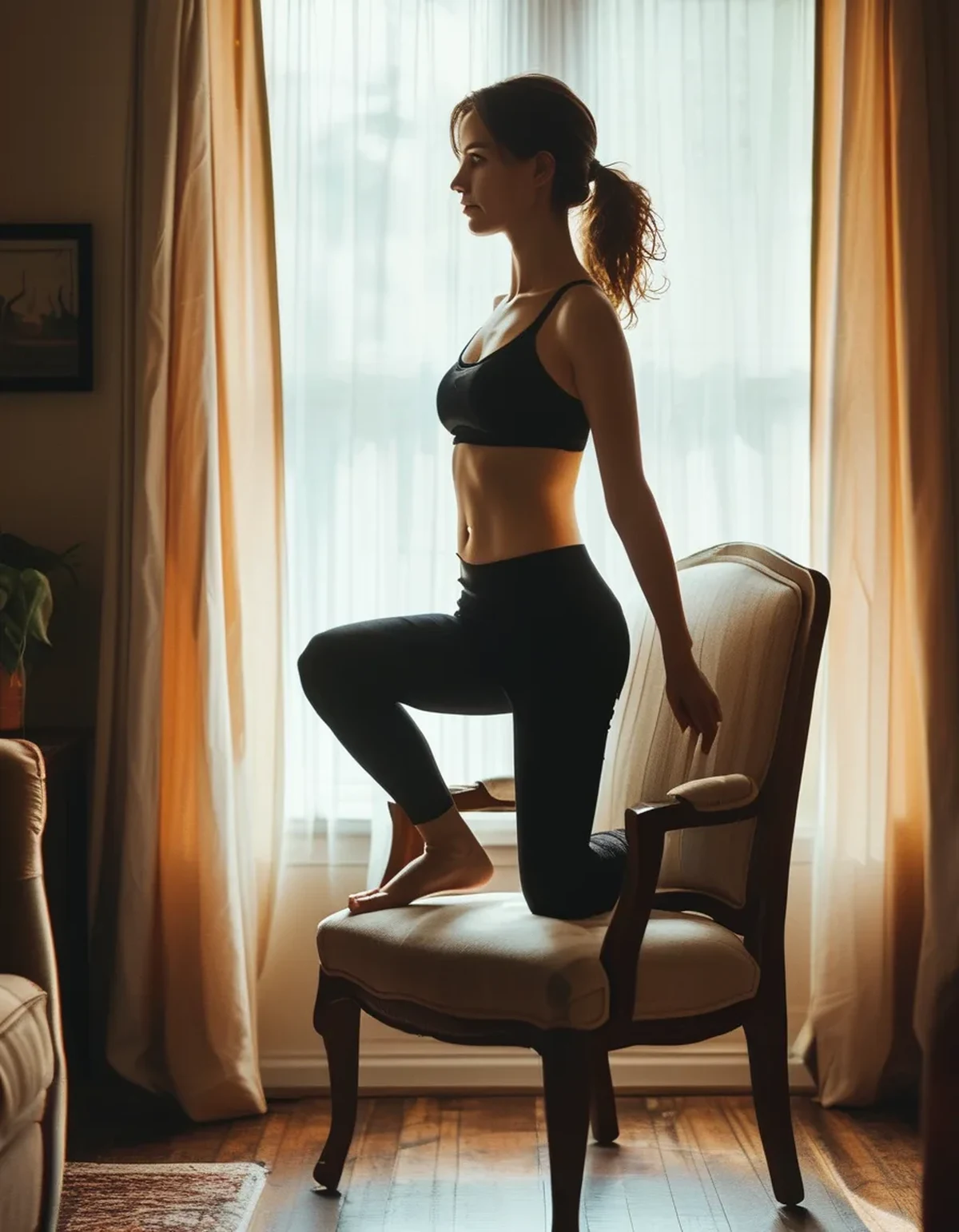
The moment of standing up from a car seat includes a brief single-leg phase, particularly if one foot is still inside the vehicle.
Stand behind a chair with hands lightly resting on it. Shift your weight fully onto one leg, lift the other foot an inch off the floor, hold for 10 seconds, and return. Five each side.
Reduce the hand support progressively. Two hands, then one hand, then fingertips, then hover. Fingertip contact provides surprisingly large stability benefit, so moving from fingertips to no contact is a bigger step than it looks and deserves its own weeks.
Do not close your eyes at this stage. Eyes-closed balance work is a legitimate progression, but it is not what the car task requires - and the sequence you are training is one where vision is available and useful.
Progress by adding a reach. Standing on one leg while reaching forward or across with the opposite hand mimics reaching back into the car for a bag, which is exactly the moment people describe as the one where they wobble.
Drill 5: The loaded version
Almost nobody gets out of a car empty-handed, and carrying changes balance in three ways: it shifts your center of mass, it occupies a hand that would otherwise stabilize, and it blocks part of your view of the ground.
Repeat drills 1 and 3 while holding a bag on one side. A shopping bag with a few tins in it is a realistic load. Notice how much harder the single-sided version is than the balanced one.
Practice the same movements holding something with both hands. A box held in front is a different challenge - it moves the center of mass forward and blocks your view of your feet.
Then practice putting it down first. The most useful thing this drill teaches most people is that setting a bag on the seat or the roof, standing up unloaded, and then picking it up is dramatically safer and takes three extra seconds. Learning that in your living room is better than learning it in a car park.
Build to a full sequence. Sit, pivot, stand while holding a bag, step up onto the step, turn your head. That is the entire real-world task, rehearsed somewhere it costs nothing to get wrong.
And practice a few times a week rather than occasionally. Balance responds to frequency more than duration - five to ten minutes several times a week outperforms one long session, and improvements in this kind of task-specific practice typically show up within a few weeks. This is general information, not medical advice - anyone with dizziness, a history of falls, or a specific condition should get individual guidance.
FAQ: Balance for Car Transfers, Answered
What is the safest way to get out of a car?
Swing both legs out together with the knees together, get both feet flat on the ground, then stand using the doorframe rather than the door for support. Setting bags down before standing removes the load and frees a hand.
Why is getting out of a car harder than standing up at home?
It stacks four demands at once - a low seat, a rotation, a brief single-leg phase, and a step onto an often uneven or higher surface - usually while carrying something. Most balance training practices those elements separately rather than combined.
How often should I practice balance drills?
Frequency matters more than length: five to ten minutes several times a week outperforms one long weekly session. Task-specific practice like this typically produces noticeable improvement within a few weeks.
Should I practice with my eyes closed?
Not for this task. Eyes-closed work is a legitimate progression for general balance, but the car transfer is a movement where vision is available and useful - training it with the head turn instead is far more transferable.
TL;DR:
- Getting out of a car stacks a low seat, a rotation, a single-leg moment, and an unpredictable kerb - four demands most balance training practices separately.
- Train the low-seat sit-to-stand without hands, and slow the lowering phase where most of the benefit is.
- Practice the seated pivot with knees together on a slippery surface, then combine it with standing as one sequence.
- Step-ups to varying heights with a head turn at the top rehearse the kerb moment that catches people out.
- Add a bag to the drills - and discover that setting it down first is worth the three extra seconds.
The car park version is the real test, and rehearsing it in your living room is free. Practice a few times a week and it gets noticeably easier within a month. This is general information, not medical advice.
Keep Reading
This article is for general informational purposes only and is not medical advice. Always consult a qualified health professional for guidance specific to you.