5 Balance Checks You Can Do at Home This Week
Quick Answer: Five simple tests cover the main components of balance: single-leg stance with eyes open, single-leg stance with eyes closed, tandem stance, sit-to-stand repetitions, and a timed walk with a head turn. Do all five near a counter with support within reach. Single-leg stance is the most informative - the ability to hold it for around 10 seconds has been linked in research to meaningful health outcomes in middle-aged and older adults. Retest monthly, because balance responds to training faster than almost any other physical quality.
Nobody notices balance declining. It is not painful and it does not announce itself - right up until the moment it matters on a wet step. Five minutes of testing gives you a number to work with.

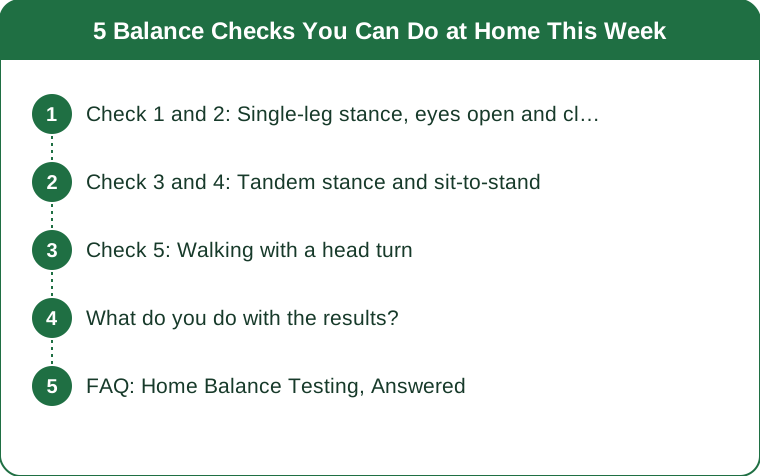
Check 1 and 2: Single-leg stance, eyes open and closed
Check 1: Single-leg stance, eyes open
How to do it: Stand near a counter with support within arm’s reach. Lift one foot a few inches off the ground without resting it against the other leg. Time how long you hold it, up to 30 seconds. Test both sides.
What it means: This is the most studied single measure of balance. Research has linked the inability to complete around 10 seconds of single-leg stance with poorer health outcomes in middle-aged and older adults, and the test appears repeatedly in clinical screening.
Rough reference points: Being comfortable at 30 seconds per side is a good place to be. Under 10 seconds is worth taking seriously as a training target and worth mentioning to a clinician.
Note the asymmetry. A meaningful difference between sides - say 25 seconds on one and 8 on the other - is informative in itself, and often points to an old ankle injury or a hip that has been quietly under-working.
Check 2: Single-leg stance, eyes closed
How to do it: Same setup, eyes closed, support definitely within reach. Expect a dramatic drop.
What it means: Closing your eyes removes vision, which is the input most people rely on most heavily. What remains is vestibular and proprioceptive information, and this test isolates them.
Reference points are much shorter. Even people with good balance often manage only 5 to 15 seconds here, and times decline substantially with age. A very short time with eyes closed alongside a good time with eyes open suggests a heavy reliance on vision - which is exactly the vulnerability that shows up in dim light or on uneven ground.
Check 3 and 4: Tandem stance and sit-to-stand
Check 3: Tandem stance
How to do it: Stand with one foot directly in front of the other, heel touching toe, as though on a line. Hold for up to 30 seconds, then swap feet.
What it means: This narrows your base of support side to side, which challenges lateral stability specifically - the direction most relevant to sideways stumbles and to walking on uneven surfaces.
Progress it by closing your eyes once 30 seconds is comfortable with them open, which combines the challenges of the first two tests.
Check 4: Thirty-second sit-to-stand
How to do it: Sit in a standard chair without arms, feet flat, arms crossed over your chest. Stand fully and sit back down as many times as you can in 30 seconds.
What it means: This is a lower-body strength and power test, and it is on this list because leg strength is inseparable from balance. Recovering from a stumble requires generating force quickly, and no amount of proprioceptive skill compensates for legs that cannot produce it.
Rough reference points: Published normative values vary by age and sex, but broadly, fewer than 10 to 12 repetitions in someone over 60 is generally considered below average and worth addressing with strength work.
This is often the most actionable result on the list, because leg strength responds reliably and relatively quickly to training - and improvements here tend to show up in the other four tests as well.

Check 5: Walking with a head turn
How to do it: Walk 20 feet at your normal pace while turning your head side to side, as if looking at shelves in a shop. Note whether your path stays straight and whether you feel unsteady.
What it means: This is the most functionally relevant test on the list, because it replicates real life - almost nobody falls while standing still on one leg with full attention on balancing. Falls happen while walking, turning, carrying, and looking at something else.
What to watch for: Veering off a straight line, needing to slow down noticeably, or a feeling of dizziness or unsteadiness during the head turns. Any of these is worth mentioning to a healthcare provider, particularly the dizziness.
Add the dual-task version if the first is easy. Walk the same distance while counting backwards from 100 by threes. Balance requires attentional resources, and a marked deterioration when you add a cognitive task is a well-documented predictor of fall risk.
Do this one with someone nearby. It is the test most likely to produce genuine unsteadiness, and it is not one to attempt alone if you have any history of dizziness or falls.
And note what the whole set tells you together. Good static balance with poor dual-task walking is a common and important pattern - it means the underlying capacity is there but it is not available when your attention is elsewhere, which is precisely when you need it.
What do you do with the results?
Train the specific thing that scored poorly. Poor eyes-closed stance means training with reduced visual input - single-leg stance with eyes closed near a counter, 3 sets of 20 to 30 seconds per side. Poor sit-to-stand means strength work. Poor dual-task walking means practicing exactly that, safely.
Balance improves quickly, which is the encouraging part. Much of the early adaptation is neural, so noticeable improvement over four to six weeks of near-daily practice is typical.
Practice daily and briefly rather than weekly and long. Two minutes while brushing your teeth, done every day, beats a 20-minute session once a week by a wide margin.
Add strength training regardless of your scores. Lower-body strength underpins every balance test on this list, and progressive resistance training has the strongest evidence base for reducing falls in older adults - typically alongside balance training rather than instead of it.
Retest monthly. Improvement is genuinely motivating here in a way that few fitness metrics are, and it takes five minutes.
And see a professional for the warning signs: any dizziness or vertigo, a fall in the past year, a sudden change in balance, or numbness in the feet. These point to specific and often treatable causes - vestibular problems, medication side effects, neuropathy, vision changes - and they are worth investigating rather than training around.
This is general information, not medical advice.
FAQ: Home Balance Testing, Answered
How long should I be able to stand on one leg?
Being comfortable at 30 seconds per side with eyes open is a good target. Research has linked the inability to hold around 10 seconds with poorer health outcomes in middle-aged and older adults, so under 10 seconds is worth treating as a training priority.
Why is balancing with my eyes closed so much harder?
Vision is the input most people rely on most heavily for balance. Closing your eyes leaves only vestibular and proprioceptive information, and a large gap between your eyes-open and eyes-closed times means heavy visual reliance - which becomes a problem in dim light or on uneven ground.
How quickly can balance improve?
Noticeably within four to six weeks of near-daily practice, since much of the early gain is neural rather than structural. Short daily sessions work far better than one long weekly session.
What is the best exercise for balance?
Single-leg stance progressions combined with lower-body strength training. Balance practice trains the control, and strength gives you the ability to actually recover from a stumble - the two together have much better evidence than either alone.
When should I see a doctor about my balance?
For any dizziness or vertigo, a fall within the past year, a sudden change in balance, or numbness in your feet. These can point to vestibular problems, medication effects, neuropathy, or vision changes, all of which are worth identifying rather than training around.
TL;DR:
- Five tests cover the main components: single-leg stance eyes open and closed, tandem stance, 30-second sit-to-stand, and walking with head turns.
- Single-leg stance is the most informative measure; around 10 seconds is a meaningful threshold and 30 seconds per side is a good target.
- A large gap between eyes-open and eyes-closed times means heavy visual reliance, which becomes a problem in dim light and on uneven ground.
- Sit-to-stand is the most actionable result, because leg strength underpins every other test and responds quickly to training.
- Practice two minutes daily rather than 20 minutes weekly, add strength training, and retest monthly.
- See a provider for dizziness, a fall in the past year, sudden changes, or numbness in the feet. This is general information, not medical advice.
Five minutes and a kitchen counter. It is the cheapest useful measurement you can take of yourself this month, and it is the one most likely to change something.
Keep Reading
This article is for general informational purposes only and is not medical advice. Always consult a qualified health professional for guidance specific to you.