5 Ways to Tell Your Balance Training Is Actually Working
Quick Answer: Balance progress shows up as longer single-leg hold times, steadier everyday movements like stepping off curbs, and quicker recovery from a stumble — these trackable signs matter more than how balance training looks or feels session to session.
Balance training doesn’t build visible muscle the way strength training does, so it’s easy to wonder if it’s doing anything. Here are 5 concrete signs it is.

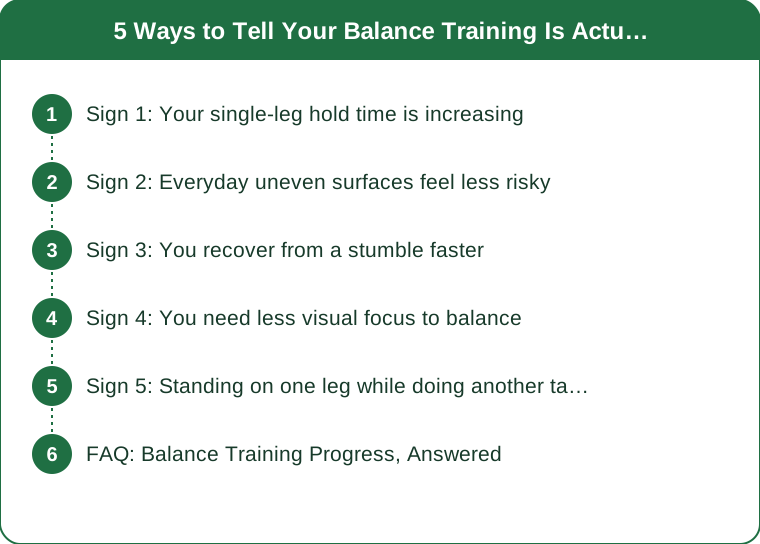
Sign 1: Your single-leg hold time is increasing
Time yourself holding a single-leg stand (eyes open, then eyes closed if comfortable) once every couple of weeks. An increasing hold time is direct, measurable proof of improving balance.
Sign 2: Everyday uneven surfaces feel less risky
Curbs, gravel paths, and uneven sidewalks feeling more stable underfoot is a real-world sign your balance training is transferring outside the gym, which is ultimately the point.
Sign 3: You recover from a stumble faster
A near-trip that used to mean grabbing for support now resolves with a quick, controlled correction — that faster recovery reflects genuine improvement in your reactive balance system.

Sign 4: You need less visual focus to balance
Early in training, most people stare at the floor to balance. As proprioception improves, holding balance while looking around or even with eyes briefly closed becomes more manageable.
Sign 5: Standing on one leg while doing another task feels easier
Multitasking during balance work — like standing on one leg while putting on a sock — is a strong marker of real functional improvement, since it demonstrates balance holding up under divided attention.
FAQ: Balance Training Progress, Answered
How often should I test my balance progress?
Every 2-3 weeks is frequent enough to see a trend without daily fluctuation making it look inconsistent.
How long does it typically take to see balance improvement?
Many people notice measurable single-leg hold time improvements within 4-6 weeks of consistent training.
Is it normal for balance to feel worse some days?
Yes — fatigue, sleep, and even minor illness can affect balance day to day. Look at the overall trend across weeks, not single sessions.
TL;DR:
- Longer single-leg hold times are the clearest measurable sign of progress
- Uneven surfaces feeling more stable means training is transferring to real life
- Faster recovery from a stumble reflects genuine reactive balance improvement
- Track trends across weeks, not single sessions — day-to-day variation is normal
Balance progress is easy to miss without tracking — these 5 signs make it visible.
Keep Reading
This article is for general informational purposes only and is not medical advice. Always consult a qualified health professional for guidance specific to you.