3 Balance Training Habits That Quietly Stall Your Progress
Quick Answer: Balance training stalls most often because the exercises never get harder, sessions are too short to challenge the system, or eyes stay open the whole time. Progressive difficulty — not just repetition — is what drives real improvement.
You’ve been doing the same balance routine for weeks and it still feels exactly as wobbly as day one. That’s not a sign balance training doesn’t work for you — it’s usually a sign the exercise stopped being a challenge weeks ago.

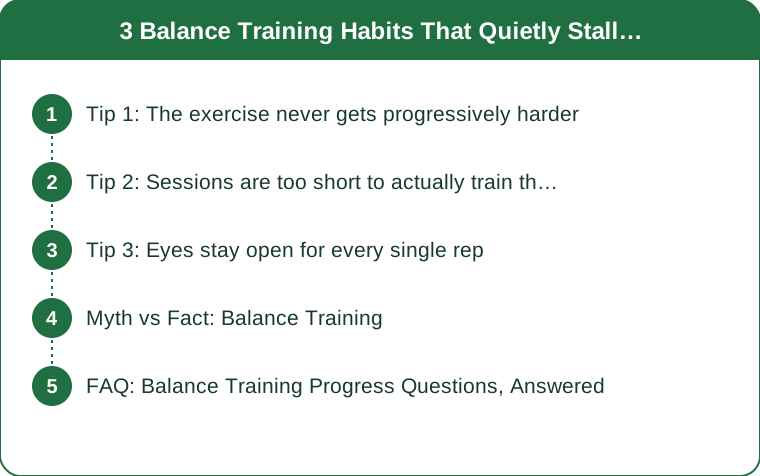
Tip 1: The exercise never gets progressively harder
Balance improves through progressive challenge, same as strength training. If you’re still doing the exact same single-leg stand at week 6 that you did at week 1, your nervous system has already adapted and stopped improving. Add a head turn, a soft surface, or shorter support time to keep it demanding.
Tip 2: Sessions are too short to actually train the system
Holding a balance position for 10 seconds barely engages the postural correction system — real adaptation tends to need 30-45 seconds per hold, repeated across 3-4 sets. Shorter holds feel productive but often aren’t long enough to trigger meaningful change.

Tip 3: Eyes stay open for every single rep
Vision compensates heavily for balance, which is exactly why closing your eyes (even briefly, and only once you’re stable and near support) forces the vestibular and proprioceptive systems to do more work. Skipping this step means a big chunk of the balance system never gets challenged at all.
Myth vs Fact: Balance Training
Myth: Balance is something you either have or don’t. Fact: Balance is trainable at any age through the same progressive-overload principle used in strength training — plateau usually means the challenge level stalled, not that balance itself is fixed.
Myth: More balance exercises is better than harder balance exercises. Fact: Ten easy exercises done daily improve less than three exercises that are actually difficult and progressed weekly.
Myth: Balance training is only for older adults. Fact: Balance capacity starts declining as early as your 30s, well before it becomes noticeable — training it earlier keeps the decline from ever becoming a fall risk.
FAQ: Balance Training Progress Questions, Answered
How often should balance training difficulty increase?
Roughly every 1-2 weeks, once a hold feels stable and controlled rather than wobbly for the full duration — that’s the signal it’s time to add a variable.
Is it normal for balance to feel worse on some days?
Yes — fatigue, poor sleep, and even dehydration measurably affect balance performance day to day, so don’t judge overall progress from a single off session.
Do I need equipment to progress past the basics?
No — a folded towel, a step, or simply closing your eyes near a wall for safety covers most of the progression most people need before equipment becomes worth it.
TL;DR:
- Progress stalls when the exercise never gets harder — balance needs progressive overload too
- Hold times under 15-20 seconds are often too short to trigger real adaptation
- Closing your eyes (safely, near support) challenges the system in a way open-eyed reps don’t
- Balance is trainable at any age — a plateau means the challenge stopped increasing
This week, add one variable — shorter support, a head turn, or closed eyes — to whatever balance exercise has felt easy lately.
Keep Reading
This article is for general informational purposes only and is not medical advice. Always consult a qualified health professional for guidance specific to you.