Balance Testing and Training: 5 Tests You Can Do at Home and What Your Score Means
Quick Answer: Five simple tests cover most of what a clinic would check: single-leg stance eyes open, single-leg stance eyes closed, tandem stance, the sit-to-stand test, and a timed up-and-go. Test yourself next to a counter, note the numbers, and retest every four weeks. The test you score worst on tells you exactly which system - strength, vision, or inner ear - to train first.
Most balance advice tells you to do more balance training. Almost none of it tells you how to find out where you actually stand. That’s what testing is for, and it takes ten minutes.

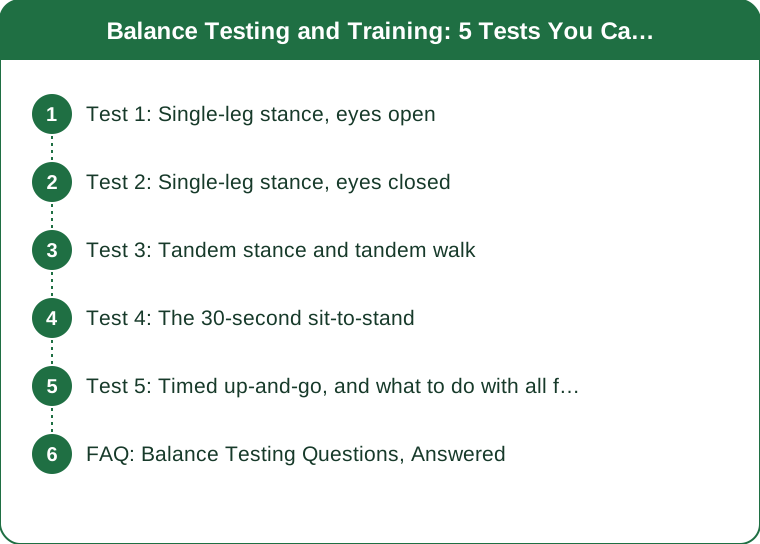
Test 1: Single-leg stance, eyes open
How to do it: Stand next to a counter with your hand hovering, not resting. Lift one foot so the ankle is near the opposite calf, arms crossed on your chest. Time how long you hold before you touch down, grab the counter, or the standing foot shifts.
What good looks like: Commonly used reference ranges put a healthy adult under 40 comfortably above 40 seconds, with the expected time declining through the decades - the fifties and sixties typically land in the 20-30 second range, and under 10 seconds at any age is generally treated as a meaningful finding worth acting on.
What it tells you: This is your baseline composite score. It uses vision, inner ear, and ankle strength together, so it’s a good headline number and a poor diagnostic - it tells you that something is off, not what.
Test both sides and note the difference. A gap of more than about 30% between legs is worth more attention than either individual number, because it usually points at an old ankle injury or a hip strength asymmetry that’s still there years later.
Do this one first, on both sides, before you’re tired.
Test 2: Single-leg stance, eyes closed
How to do it: Same setup, hand near the counter, but eyes shut. Have something solid within reach - this one drops off fast and everybody is worse at it than they expect.
What good looks like: The numbers fall dramatically once vision is removed. Holding around 20-25 seconds is strong for a younger adult, and the commonly cited expectation drops into single figures through the fifties and sixties. Under 5 seconds in middle age is a genuine flag, not a curiosity.
What it tells you: This is the single most informative test of the five, because it isolates the two systems that decline quietly. With eyes open, vision can compensate for a weak vestibular system and you’ll never know. Close your eyes and the inner ear and the sensors in your feet and ankles have to carry the whole job alone.
The most useful comparison is the ratio. If you hold 45 seconds with eyes open and 3 seconds with eyes closed, you’re a vision-dependent balancer - your body has been quietly outsourcing balance to your eyes. That’s the profile most associated with trouble on stairs at night, in dim restaurants, and on uneven ground.
If this is your worst test, prioritise the eyes-closed and head-turn drills in the training section.
Test 3: Tandem stance and tandem walk
How to do it: Stand heel-to-toe in a straight line, one foot directly in front of the other, arms crossed. Hold for 30 seconds. Then walk 10 steps heel-to-toe along a line on the floor without stepping off.
What good looks like: Holding the static tandem position for a full 30 seconds is the standard target, and it’s used as a screening threshold in clinical batteries. For the walk, 10 clean steps without a sideways correction or an arm-out save.
What it tells you: Tandem stance narrows your base of support to almost nothing side-to-side, which specifically loads lateral hip control - the gluteus medius doing the work of keeping your pelvis level. If you can hold single-leg stance for 30 seconds but wobble in tandem, your problem is hip strength, not balance perception.
That distinction matters a lot for what you train. Perception problems respond to sensory drills; lateral hip weakness responds to side-lying leg raises, banded walks, and single-leg deadlifts, and no amount of standing on a wobble cushion will fix it.
Add the head turn version once the basic hold is easy: tandem stance while slowly turning your head left and right. This is where a lot of people who scored fine suddenly don’t.

Test 4: The 30-second sit-to-stand
How to do it: Sit in a standard dining chair, arms crossed over your chest, feet flat. Count how many full stands you complete in 30 seconds. Full means standing all the way up and sitting all the way back down, no hands.
What good looks like: Published age norms put healthy adults in their fifties and sixties in roughly the 12-17 range, with the expected count declining through later decades. Below about 10 in middle age is the number that most often prompts a conversation about lower-body strength.
What it tells you: This isn’t a balance test at all, and that’s exactly why it’s on the list. A large share of real-world balance failures are strength failures wearing a balance costume - you don’t fall because you can’t perceive the wobble, you fall because your legs can’t produce force fast enough to catch it.
If this is your weakest test relative to the norms, stop doing balance drills as your primary work and go do strength training. Squats, step-ups, split squats, and loaded carries will do more for your balance than a year on a foam pad.
This is also the test that responds fastest. Sit-to-stand counts typically improve within 4-6 weeks of twice-weekly lower-body strength work, which makes it satisfying to retest.
Test 5: Timed up-and-go, and what to do with all five scores
How to do it: Sit in a chair. On go, stand, walk 3 metres, turn around, walk back, and sit down. Time the whole thing. Use your normal walking pace and normal footwear.
What good looks like: Healthy independent adults typically complete this comfortably under 10 seconds. Times drifting toward and past 12 seconds are what clinicians treat as a screening flag worth following up.
What it tells you: This is the functional composite - it bundles standing strength, walking, turning, and the transitions between them. The turn is the informative part. Most people who score poorly lose their time in the turn, because turning requires momentary single-leg support while rotating, which is precisely the combination that fails first.
Now read your five scores together:
- Worst on eyes-closed → sensory and vestibular work: eyes-closed holds, head turns, foam surfaces, walking with head rotation.
- Worst on tandem → lateral hip strength: side-lying abduction, banded lateral walks, single-leg deadlifts.
- Worst on sit-to-stand → straight strength training, twice weekly, progressively loaded.
- Worst on timed up-and-go → practise turns specifically, and add the sit-to-stand work.
- Even across all five but all low → start with strength, because it underpins the rest.
Retest every four weeks, same time of day, same shoes, and write the numbers down. The single most common reason balance training gets abandoned is that progress is invisible without measurement - and these five numbers make it visible. This is general information, not medical advice; if you’ve had a fall, dizziness, or a sudden change in balance, get assessed properly.
FAQ: Balance Testing Questions, Answered
How often should I retest?
Every four weeks is the sweet spot. Weekly testing mostly captures noise from sleep, fatigue, and time of day; monthly is long enough for real change to show.
Does time of day really matter?
Yes, more than most people expect. Balance is typically better mid-morning than late evening, and worse when tired or dehydrated. Test at the same time so you’re comparing like with like.
Should I test barefoot or in shoes?
Barefoot for the single-leg and tandem tests, since you want the foot and ankle sensors involved. Normal shoes for the timed up-and-go, because that one is meant to reflect real walking.
What if I can’t do the eyes-closed test at all?
That’s useful information, not a failure. Start with eyes closed in tandem stance or two-foot stance on a cushion, and build toward single-leg over several weeks.
TL;DR:
- Five tests - single-leg eyes open, eyes closed, tandem, 30-second sit-to-stand, timed up-and-go
- Eyes-open vs eyes-closed ratio reveals whether you’re outsourcing balance to your vision
- Tandem failure points at lateral hip strength, not perception
- A low sit-to-stand count means train strength first; balance drills won’t substitute
- Retest monthly, same time of day, same shoes, and write it down
Train the test you fail, not the one you enjoy. That’s the entire method.
Keep Reading
This article is for general informational purposes only and is not medical advice. Always consult a qualified health professional for guidance specific to you.