5 Balance Drills for 5 Different Moments You Can Actually Fit Them Into
Quick Answer: Balance drills work best attached to existing daily moments rather than a separate session: single-leg stance while brushing teeth, heel-to-toe walk during a hallway pass, weight shifts while waiting for coffee, a stability challenge during TV time, and a wobble-surface drill post-shower — matching the drill to the moment makes consistency far easier.
The biggest reason balance training gets skipped isn’t difficulty — it’s that it needs its own calendar slot most people don’t have. Attaching specific drills to moments that already happen daily removes that barrier almost entirely.

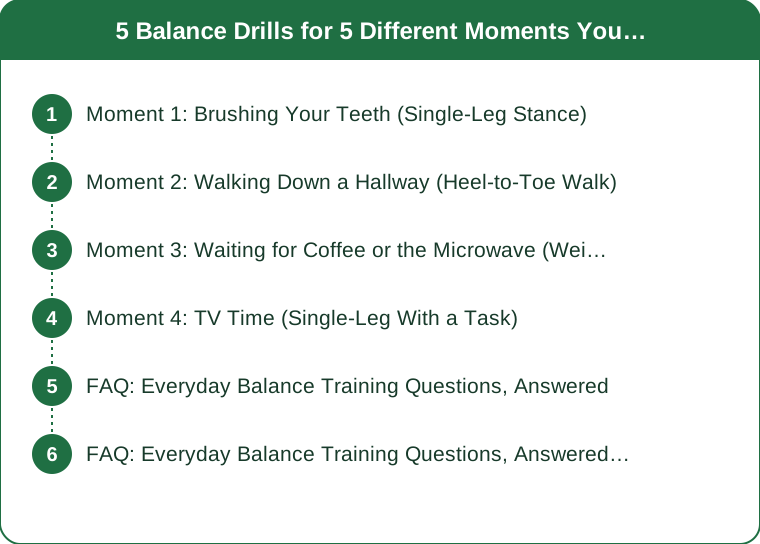
Moment 1: Brushing Your Teeth (Single-Leg Stance)
Two minutes of brushing is already a fixed daily block. Stand on one leg for the first minute, switch for the second — no extra time required, no extra decision needed.
Progress over weeks by closing your eyes for a portion once single-leg stance feels stable and easy with eyes open.
Moment 2: Walking Down a Hallway (Heel-to-Toe Walk)
Any hallway pass at home becomes a heel-to-toe balance walk — placing one foot directly in front of the other, heel touching toe, for 10-15 steps.
This is a classic balance-assessment movement used by physical therapists, and doing it during an already-happening walk costs zero extra time.
Moment 3: Waiting for Coffee or the Microwave (Weight Shifts)
Standing and waiting is dead time perfectly suited for slow, controlled weight shifts — side to side, then front to back, for the 60-90 seconds most brewing or microwave cycles take.
This specifically trains the ankle and hip stabilizers responsible for catching small balance losses in daily life, not just static hold ability.

Moment 4: TV Time (Single-Leg With a Task)
During a commercial break or a slower scene, stand on one leg while doing something else — folding laundry, sorting mail — which adds a dual-task element closer to how balance actually gets challenged in real life.
Real falls rarely happen while standing still and focused; they happen while attention is split, which makes this dual-task version more functionally useful than isolated static holds.
FAQ: Everyday Balance Training Questions, Answered
Do these small moments really add up to meaningful balance improvement?
Yes — consistency across short, frequent practice is generally associated with meaningful improvement over weeks, often comparably to a single longer dedicated session.
Is it safe to do balance drills without holding onto anything?
For most healthy adults starting out, yes near a stable surface for backup — anyone with significant balance concerns or a fall history should check with a doctor or PT before practicing unsupported.
FAQ: Everyday Balance Training Questions, Answered (continued)
How long before these small daily moments show noticeable improvement?
Many people notice a difference in stability within 3-4 weeks of consistent daily practice, even in short bursts attached to existing routines.
TL;DR:
- Attaching balance drills to existing daily moments removes the biggest consistency barrier
- Teeth-brushing, hallway walks, and waiting time all double as free balance practice
- Dual-task balance (standing while doing something else) reflects real-life fall risk better than static holds alone
- Consistent short practice adds up comparably to a single longer dedicated session
Balance training doesn’t need a calendar slot — it needs a moment you’re already standing in anyway.
Keep Reading
This article is for general informational purposes only and is not medical advice. Always consult a qualified health professional for guidance specific to you.