Close Your Eyes and You Wobble: What That Reveals About Your Balance
Quick Answer: Balance runs on three inputs - vision, the inner ear’s vestibular system, and proprioception (position sense from feet, ankles, and joints). Most adults quietly over-rely on vision, so closing the eyes exposes how weak the other two channels have become. That matters because real life constantly degrades vision - dark hallways, night bathroom trips, looking at your phone while walking. The fix is training with vision removed or busy: eyes-closed stance progressions, head turns while balancing, and textured-surface work, two minutes a day beside a counter.
Try it now, somewhere safe: stand on one leg. Fine, probably. Now close your eyes. If the countdown to a hop-and-catch was under five seconds, you just met your balance system’s biggest secret - and its most fixable one.

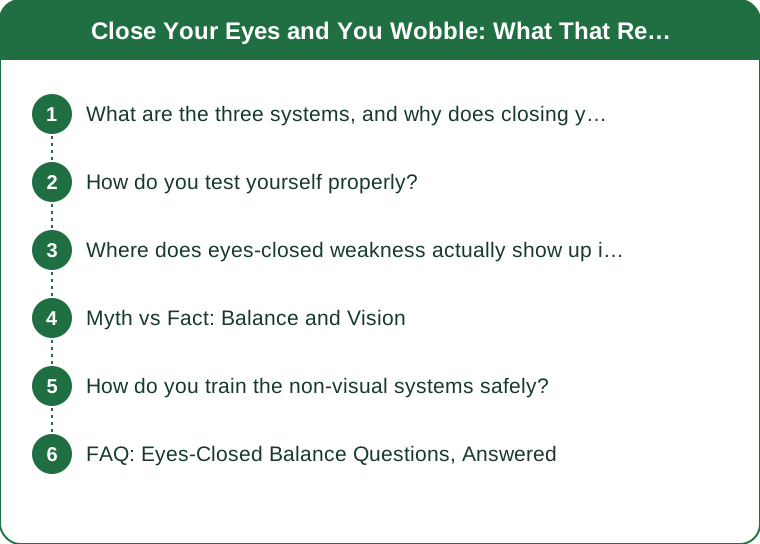
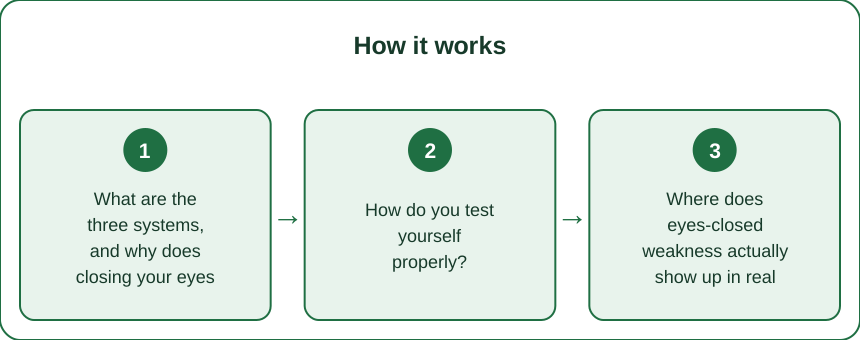
What are the three systems, and why does closing your eyes cause chaos?
Balance is a continuous negotiation between three information streams, blended in the brain dozens of times per second:
Vision reports where you are relative to the world - the horizon, the doorframe, the floor. It is the highest-resolution stream and the one modern life leans on hardest.
The vestibular system - fluid-filled canals and gravity sensors in the inner ear - reports head motion and tilt. It works in darkness, but its signals are subtler and the brain trusts them less when vision is available.
Proprioception streams up from pressure sensors in the feet and position sensors in ankles, knees, and hips: which way you are drifting, how hard each part of the foot is pressing. It is the fastest loop for the small corrections one-leg standing requires.
Healthy balance weights all three and re-weights instantly as conditions change. But the weighting follows use - and a life of flat floors, supportive shoes, good lighting, and constant visual anchoring lets vision quietly take over the committee. The other two channels, under-consulted, get noisy and slow.
Close your eyes and the takeover is exposed: the dominant stream cuts out, the brain reaches for vestibular and proprioceptive data it has been ignoring, and the first seconds of wobble are literally the sound of rusty channels being turned back up.
Some instability with eyes closed is universal and normal - everyone sways more. The finding worth acting on is the size of your gap: rock-solid with eyes open, instantly chaotic without. That gap is vision doing three jobs - and it is trainable at any age.
How do you test yourself properly?
Two minutes, next to a counter or sturdy chair, shoes off:
Test 1 - the timed one-leg stand, eyes open. Arms relaxed, lifted foot clear of the standing ankle, no hooking. Time until the foot touches down or you grab support. Do both legs. Broad reference points: 30-plus seconds is solid; under 10 in midlife or beyond is a flag worth taking seriously, since one-leg stance time correlates with fall risk in older-adult research.
Test 2 - the same stand, eyes closed. Same setup, fingertips hovering an inch above the counter. Expect a dramatic drop - that is normal. Reference points: 10-plus seconds is genuinely good; 5 to 10 is typical and trainable; under 3 to 5 seconds signals heavy visual dependence.
The number that matters most is your ratio. Forty seconds open but three closed is a different profile than fifteen open and eight closed - the first is visual over-reliance, the second is a general balance project. Note both numbers and both legs; a large left-right gap is its own useful finding.
Retest every two weeks, same time of day (balance is worse when tired), and expect the closed-eyes number to move surprisingly fast - it is the most responsive metric in this article.
One screening caveat: this tests balance fitness. Spinning sensations, sudden new unsteadiness, vertigo triggered by rolling over in bed, or balance that worsened abruptly are symptoms, not fitness gaps - those deserve a medical assessment, and often respond beautifully to specific treatment. This is general information, not medical advice.
Where does eyes-closed weakness actually show up in real life?
Nobody walks around with closed eyes - but life removes or degrades vision constantly, and those are exactly the moments balance incidents cluster:
The dark house. The 3am bathroom walk is the classic: low light, sleep-fogged brain, bare feet - vision degraded, vestibular system groggy, proprioception on its own. Falls at home concentrate at night for precisely this reason, and the eyes-closed test is a fair preview of your 3am self.
The occupied gaze. Walking while reading a phone, scanning shelves while stepping around a cart, looking at your companion instead of the trail - vision present but assigned elsewhere. A balance system that needs vision’s full attention wobbles when vision multitasks.
The moving visual world. Busy crowds, striped escalators, patterned carpets, standing on a moving bus or paddleboard - vision reporting motion that is not yours. People with strong vestibular and proprioceptive channels shrug this off; visual-dependent balancers feel unaccountably unsteady in supermarket aisles and airports.
The unreliable ground. Sand, gravel, thick grass, a dark lawn at an August evening barbecue - surfaces where foot sensors must do the reading because eyes cannot see through shoes.
And the compounding years. Vision, inner-ear sensitivity, and foot sensation all decline gradually with age - the three streams each get quieter. Training the non-visual channels now is buying redundancy before it is needed: the balance version of saving early.
The pattern across all five: your eyes-open test score is your showroom balance. The eyes-closed score is the one your night-time, phone-holding, beach-walking life actually runs on.

Myth vs Fact: Balance and Vision
Myth: Wobbling with eyes closed means something is wrong with your inner ear. Fact: In the absence of symptoms - vertigo, spinning, sudden unsteadiness - a big eyes-closed wobble almost always reflects trained visual dependence, not vestibular disease. The distinction is symptoms versus fitness: dizziness is a doctor conversation; wobble on a fitness test is a training plan.
Myth: Balance is fixed - you either have it or you do not. Fact: Balance responds to training as reliably as strength does, at every age studied. Research on balance training in older adults shows meaningful improvement and reduced fall risk within weeks of consistent practice - and the eyes-closed component improves fastest of all, because it starts from neglect rather than incapacity.
Myth: Standing on one leg while brushing teeth is enough. Fact: It is a genuinely good start - but eyes-open standing on a flat floor trains exactly one scenario. Progress requires progressive challenge: eyes closed, head turning, surface changing. Same principle as any training - the body adapts only to what it is asked.
Myth: Cushioned supportive shoes help balance. Fact: They help comfort and protect joints, but thick soft soles muffle the foot’s pressure sensors - the proprioceptive stream arrives blurred. Barefoot time at home on varied textures is a legitimate balance training input, and one reason habitual barefoot populations test well.
Myth: Falling is just part of aging. Fact: Age raises the stakes, but the largest modifiable drivers - leg strength, balance-system fitness, medication effects, home lighting, and vision correction - are all actionable. The eyes-closed number is not a fortune; it is a to-do list.
How do you train the non-visual systems safely?
Two minutes daily, always beside support, progressing one variable at a time:
Level 1 - reduce vision. Feet-together stand, eyes closed, 30 seconds. Then one leg, eyes closed, fingertips hovering over the counter - accumulate 20 to 30 seconds per leg in whatever holds you can manage. When a leg holds 15 seconds untouched, level up.
Level 2 - challenge the vestibular channel. One-leg stand, eyes open, turning your head slowly side to side, then nodding up and down - moving the head forces the inner ear to report while the visual field sweeps. Harder than it sounds. 20 seconds per leg, then repeat with eyes closed near support when ready.
Level 3 - blur the ground. One-leg stands on a folded towel, a firm cushion, or grass - the unstable surface scrambles easy foot readings and forces active proprioception. Eyes open first, then closed, then with head turns. A pillow-plus-closed-eyes hold is a genuinely advanced skill.
Level 4 - add life. Eyes-closed stands while brushing teeth (support in reach), heel-to-toe walking down the dark-ish hallway with a hand tracing the wall, one-leg stands during TV with head tracking the action, barefoot backyard time. The training works best woven into days rather than scheduled against them.
The safety frame, non-negotiable: support within a hand’s reach for every closed-eyes drill, clear floor, no socks-on-hardwood, and no closed-eyes work on stairs or near furniture corners. The point is controlled wobble - the wobble is literally the training signal - inside an environment where the worst outcome is a touch of the counter.
Expect the closed-eyes hold to double inside three to four weeks. Few fitness numbers move that fast - and few buy as much.
FAQ: Eyes-Closed Balance Questions, Answered
Why is one leg so much worse than the other?
Asymmetry is near-universal - dominant-leg habits, old ankle sprains, and one-sided daily patterns all contribute. Train both, give the weaker leg the extra set, and treat a very large or growing gap (especially post-injury) as worth a professional look. Old sprained ankles are notorious proprioception thieves, and targeted retraining recovers most of it.
Is being unable to do it at all a reason to see a doctor?
Context decides: zero seconds eyes-closed but no symptoms, in someone who has never trained balance, is common and very trainable - start at feet-together level. New or worsening unsteadiness, vertigo, spinning, or balance loss with other neurological symptoms is the medical version - book the appointment rather than the training plan.
Does yoga count as eyes-closed balance training?
Yoga’s standing balances are excellent eyes-open training, and some classes cue brief eye-closing - but most practice keeps a visual anchor (the drishti gaze is one by design). Add dedicated closed-eyes holds to get the specific adaptation; your tree pose will improve from the trade in both directions.
How long do balance gains last if I stop?
Like any fitness, it fades without use - over months, not days - but balance has an advantage: once built, it maintains on remarkably little, because daily life constantly retests it. Two minutes a few times a week holds gains that took a month to build. The habit-woven versions (teeth-brushing stands, barefoot evenings) are the ones that survive forever.
TL;DR:
- Balance blends vision, inner-ear, and foot-position senses - most adults quietly over-weight vision
- Test both ways: 30-plus seconds eyes-open is solid; under 5 eyes-closed signals visual dependence worth training
- The weakness surfaces where life degrades vision: dark hallways, phone-walking, busy visual scenes, soft ground
- Train beside a counter: eyes-closed holds, head turns while balancing, towel-and-cushion surfaces - two minutes daily
- Closed-eyes hold times typically double in a month; sudden unsteadiness or vertigo is a doctor visit, not a drill
The eyes-closed test is three seconds of honest feedback about a system you use every night of your life. Train the channels vision has been covering for, and the 3am hallway, the gravel path, and the crowded airport all quietly get easier - which is what balance training was always actually for.
Keep Reading
This article is for general informational purposes only and is not medical advice. Always consult a qualified health professional for guidance specific to you.