Balance Board or BOSU Ball? Which One Actually Fits Your Goals
Quick Answer: Balance boards train fast, reactive side-to-side and rotational stability, while BOSU balls train squat, lunge, and full-body stability on an unstable surface — pick a balance board for pure balance/proprioception work, and a BOSU for adding instability to strength exercises you already do.
Both show up in every ‘best balance equipment’ list, which makes them sound interchangeable. They’re built for different jobs, and picking the wrong one for your goal means slower progress.

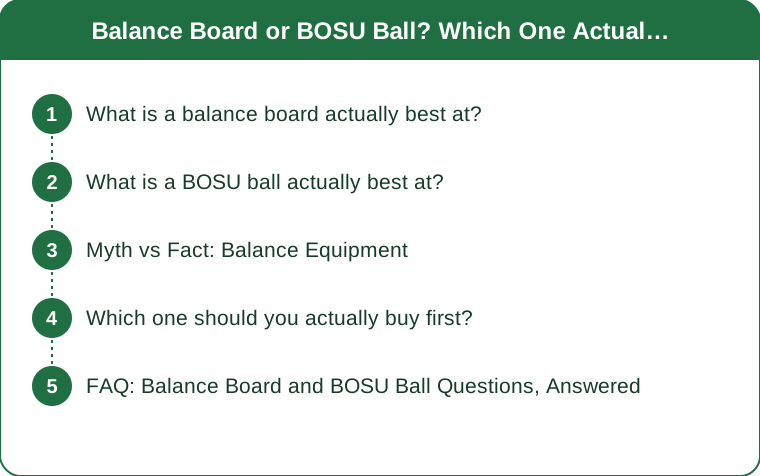
What is a balance board actually best at?
Balance boards (wobble boards, rocker boards) train fast, small, reactive corrections — the kind of quick ankle and core adjustments that matter for fall prevention, ankle rehab, and sports requiring quick footing changes.
They’re compact, cheap, and ideal if your main goal is pure proprioception and ankle stability training rather than combining balance with strength work.
What is a BOSU ball actually best at?
A BOSU (dome side up or flat side up) is primarily a strength-training instability tool — squats, lunges, push-ups, and planks done on a BOSU force stabilizer muscles to work harder throughout a familiar strength movement.
It’s the better pick if your goal is adding a balance challenge to exercises you’re already doing, rather than isolating balance training as its own thing.

Myth vs Fact: Balance Equipment
Myth: More unstable always means a better workout. Fact: Excess instability can shift focus away from the target muscle entirely, reducing strength gains — instability should challenge you, not compromise the main exercise.
Myth: You need both tools to train balance properly. Fact: Either one alone covers meaningful ground; picking based on your primary goal (reactive balance vs. strength-plus-stability) is more useful than owning both.
Myth: Balance equipment is only for older adults or rehab. Fact: Athletes across sports use both tools for injury prevention and performance, well beyond fall-prevention contexts.
Which one should you actually buy first?
If your priority is fall prevention, ankle rehab, or sport-specific reactive balance, start with a balance board — it’s cheaper and more targeted for that goal.
If your priority is making your existing strength routine more challenging (squats, planks, push-ups), a BOSU ball gets more direct use since it doubles as both a balance and strength tool.
FAQ: Balance Board and BOSU Ball Questions, Answered
Can beginners use a BOSU ball safely?
Yes, starting with the flat side down (dome up) for basic squats and lunges is the safer beginner orientation before progressing to flat-side-up work.
Do balance boards actually help prevent falls?
Research on balance and proprioception training supports it as one effective component of fall-prevention programs, particularly for older adults.
Is a wobble board the same thing as a balance board?
Yes, wobble board is essentially another name for the same category of reactive balance training tool.
TL;DR:
- Balance boards train fast, reactive proprioception; BOSU balls add instability to strength moves
- Pick based on your primary goal, not which looks more advanced
- Excess instability can reduce strength gains on the target muscle
- Balance boards are cheaper and more targeted for pure fall-prevention or ankle rehab goals
Both are useful — the right first purchase depends on what you’re actually training for.
Keep Reading
This article is for general informational purposes only and is not medical advice. Always consult a qualified health professional for guidance specific to you.