Balance and Aging: What Actually Changes at 40, 50, 60 and 70
Quick Answer: Measurable balance decline typically begins in the 40s, well before anyone notices it. The systems degrade in a rough order: sensory feedback from the feet and joints first, then vestibular function, then the muscle power needed to catch yourself. Training changes each of them, but the training differs by decade - proprioception work in your 40s, vestibular challenge in your 50s and 60s, and reactive power work from your 60s onward.
Balance is not one ability. It’s three systems reporting to a brain that combines them, and knowing which one is slipping tells you what to train.
What are the three systems, and which fails first?
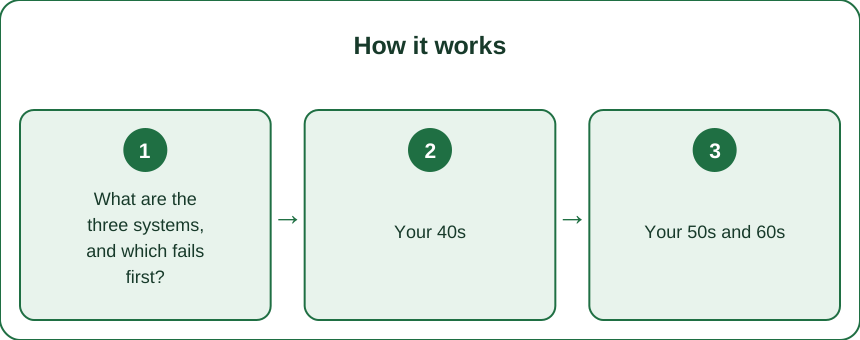
Balance comes from three inputs, and your brain weights them dynamically depending on which is most reliable.
1. Somatosensory (touch and proprioception). Pressure sensors in your feet and position sensors in your joints. This is the dominant input in normal standing - roughly 70% of the information your brain uses on a firm surface.
2. Vestibular (inner ear). Detects head position and acceleration. Takes over when the other two become unreliable - in the dark, on unstable ground.
3. Visual. Where you are relative to the world around you. The most conscious of the three and the one people over-rely on as the others fade.
The rough order of decline:
- Somatosensory declines earliest, with reduced sensation in the feet and slower proprioceptive feedback. Often begins in the 40s and is accelerated by diabetes, nerve conditions, and years in cushioned shoes
- Vestibular function declines meaningfully from around the 50s and 60s, with hair cell loss in the inner ear
- Muscle power - the ability to produce force quickly, which is what a stumble recovery requires - declines faster than muscle strength and becomes the limiting factor from the 60s
The compensation pattern that matters: as the first two fade, people rely increasingly on vision. That works until the lights go out, which is why falls disproportionately happen at night and on stairs.
Your 40s: proprioception, and why you won’t notice
The decade where measurable change begins and nobody investigates it.
What’s happening: sensory feedback from feet and ankles slows slightly. Standing balance on a firm surface with eyes open is unaffected - you’ll pass any casual test. What changes is performance on unstable surfaces and with eyes closed.
The self-test: stand on one leg with your eyes closed, near a wall. Most healthy people in their 40s manage 15-25 seconds. If you’re under 10, that’s worth acting on now rather than in twenty years.
What to train:
- Single-leg balance with eyes closed, 3 x 20 seconds per side, daily. The eyes-closed part is essential - it forces the system you’re trying to train
- Barefoot time at home, which restores sensory input the shoes suppress
- Uneven surfaces: walk on grass, gravel, or sand when you have the chance
- Ankle mobility work, since a stiff ankle can’t make the small corrections balance requires
Why it’s worth doing now: balance training in your 40s is cheap - five minutes a day, no equipment - and it’s the decade with the largest return, because you’re preserving rather than rebuilding.
The one habit to add: brush your teeth standing on one leg. Two minutes a day, twice a day, requires no schedule.
Your 50s and 60s: vestibular and reactive training
The decade where the second system starts to matter and where the training needs to get less comfortable.
What’s happening: vestibular function declines, and multitasking while balancing becomes noticeably harder. Many people first notice something when turning quickly, walking in the dark, or standing up fast.
The self-test: walk ten steps turning your head side to side as if looking at shop windows. If your walking line wanders noticeably, vestibular contribution has reduced.
What to train:
- Head turns while balancing. Stand on one leg and turn your head slowly left and right. Then up and down. This is far harder than it sounds and directly loads the vestibular system
- Gaze stabilisation: fix your eyes on a point and turn your head side to side while keeping the point in focus, 30 seconds
- Dual-task walking: walk while counting backward from 100 in sevens. Falls in real life happen while doing something else, so training should include something else
- Direction changes: figure-of-eight walking, walking backward, sidestepping
Also start in this decade: strength. Muscle power decline begins to bite, and balance without the strength to act on it is just information. Two resistance sessions a week, focused on legs and including sit-to-stands and step-ups.
Safety: do all balance work near a counter or wall. Progress by removing the hand, not by removing the safety.
Your 70s and beyond: reactive power and fall prevention
The decade where balance training becomes one of the highest-value activities available, and where the emphasis shifts.
What’s happening: all three systems have declined, and crucially the ability to produce force quickly has fallen faster than maximum strength. Recovering from a stumble requires a fast, powerful step - and speed of force production is the quality that fades most.
What the evidence supports: exercise programmes combining balance and strength training reduce falls in older adults, and are recommended in fall-prevention guidance. This is one of the better-supported interventions in the whole of preventive health.
What to train:
- Stepping practice. Fast steps in all directions - forward, backward, sideways - on cue. This trains the actual recovery movement
- Sit-to-stand, done quickly. Speed matters here, not just completion. 3 sets of 8, standing up as fast as safely possible
- Tandem stance and tandem walking - heel to toe, along a line
- Continued strength work. Legs, hips, and grip. Grip strength predicts function surprisingly well
- Tai chi, which has a notably good evidence base for fall reduction and is well tolerated
Environment matters as much as training: lighting on stairs and landings, removing loose rugs, a night light on the route to the bathroom, and reviewing medications with a doctor - several common medications increase fall risk.
Get a vision and hearing check. Both contribute to balance more than people expect, and both are correctable.
What Nobody Tells You About Balance Training
It’s extremely specific. Training balance standing still improves standing still. If you want to be steadier walking on uneven ground in the dark, you have to train something resembling that. This is why practising only the easy version plateaus quickly.
Progress is fast at first and then slow. Most people double their single-leg hold time within three to four weeks. After that, gains come from making the task harder rather than from holding longer - eyes closed, head turning, unstable surface, adding a second task.
Holding for longer than 30 seconds stops being useful. Once you can hold a position for half a minute, add difficulty rather than duration. A three-minute hold trains endurance, not balance.
Fear of falling is itself a risk factor. People who become afraid of falling reduce activity, which reduces strength and balance, which increases fall risk. Training in a safe setting where you can challenge yourself without consequence breaks that loop, and it’s one of the most valuable things a balance programme does.
Sudden balance changes are not aging. A noticeable change over days or weeks, dizziness, or vertigo deserves a medical assessment rather than more practice. Several causes are treatable, and some - like BPPV - resolve quickly with a specific manoeuvre.
Footwear matters more than people think. Very cushioned, very soft soles reduce the sensory information your feet send. A firmer, thinner sole with good fit generally supports balance better - though this is a change to make gradually.
This is general information, not medical advice - if you’ve had a fall, feel unsteady, or have any dizziness, see a doctor before starting a balance programme.
FAQ: Balance and Aging, Answered
How long can a healthy person stand on one leg?
It varies widely, but rough eyes-open reference points are around 40+ seconds in your 40s and 50s, declining through the 60s and 70s. Eyes closed drops these dramatically for everyone - 10 seconds eyes closed at 60 is respectable.
Is balance training safe to do alone?
Yes, with a counter or wall within arm’s reach. Never progress by removing your safety support - progress by removing your hand from it while it’s still there.
Does yoga or Pilates count?
Both help, and yoga in particular includes genuine single-leg balance work. Neither typically includes the reactive stepping practice that matters most from the 60s onward, so add that separately.
How often do I need to train it?
Daily, briefly, beats twice-weekly at length. Five minutes a day is the realistic target, and attaching it to an existing routine - teeth brushing, kettle boiling - is what makes it happen.
TL;DR:
- Balance uses three systems, and they decline in order: sensory, vestibular, then muscle power
- 40s: single-leg holds with eyes closed, barefoot time, uneven surfaces
- 50s-60s: head turns while balancing, dual-task walking, plus strength training
- 70s+: fast stepping practice, quick sit-to-stands, tai chi, and home environment changes
- Once you can hold 30 seconds, add difficulty rather than time
Balance decline starts two decades before anyone looks for it. Five minutes a day while the kettle boils is the entire cost of staying ahead of it.
Keep Reading
This article is for general informational purposes only and is not medical advice. Always consult a qualified health professional for guidance specific to you.